"Is this worth it?" is the wrong question. It's too vague, your brain will just rationalize whatever it wants. You'll stand in the store or hover over the "Buy Now" button and convince yourself that yes, you definitely need it. You'll find the reason later.
A better question: "How much will each use of this actually cost me?"
The Quick Answer
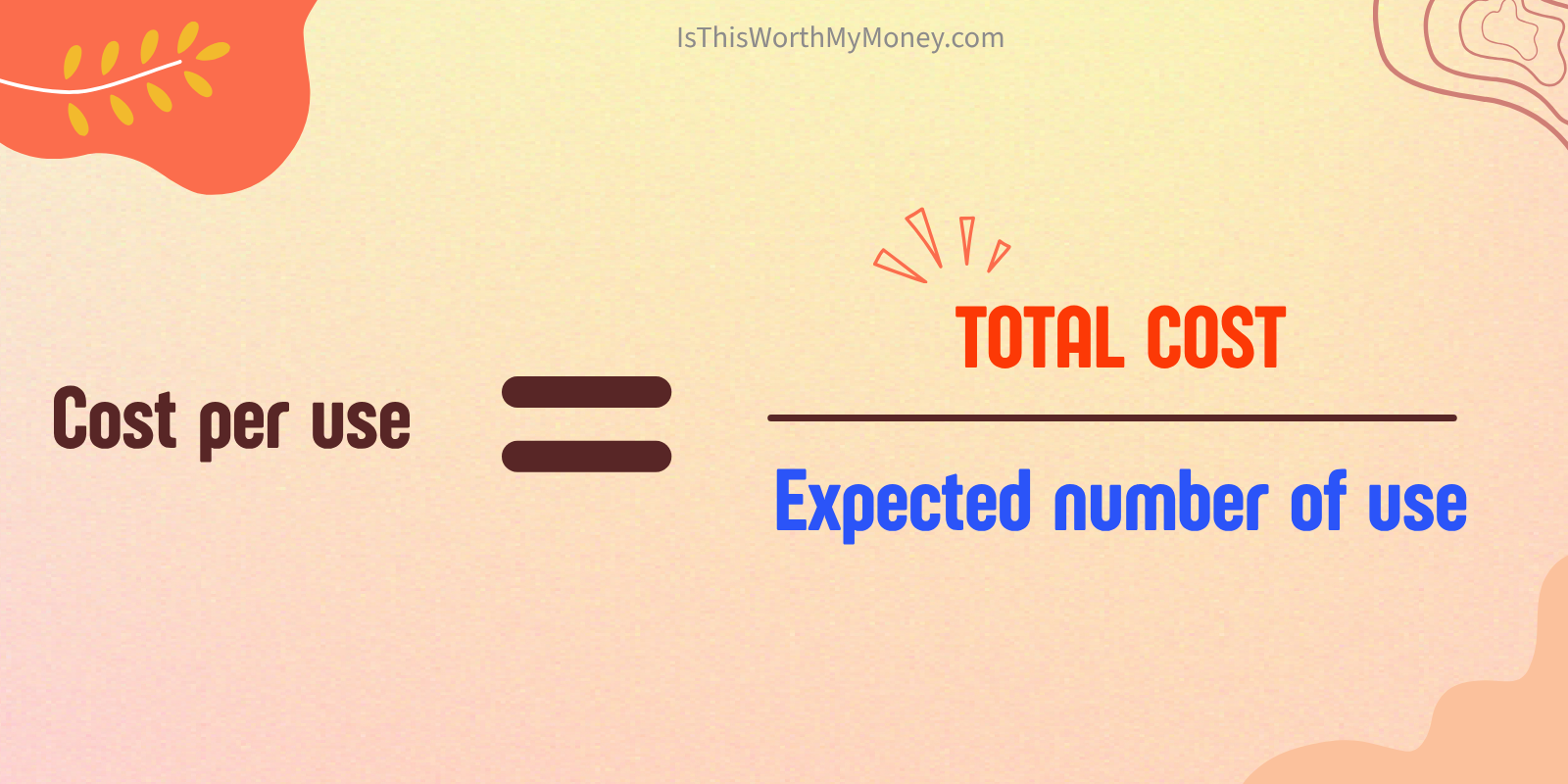
That's it. But "total cost" isn't just the price tag, it includes maintenance, subscriptions, accessories, and replacement parts. The real number is almost always higher than the sticker price.
And there's no universal threshold for what's "worth it." A phone at $0.90/day is a different kind of purchase than a bread maker at $0.90/use. The right benchmark depends on what the item does for you, and what you'd spend without it.
The real trick? Being honest about how often you'll actually use something, not how often you plan to.
How to Calculate Cost Per Use (the Full Formula)
Here's the formula most people get wrong: they only look at the purchase price. But the true cost of owning something is almost always higher.
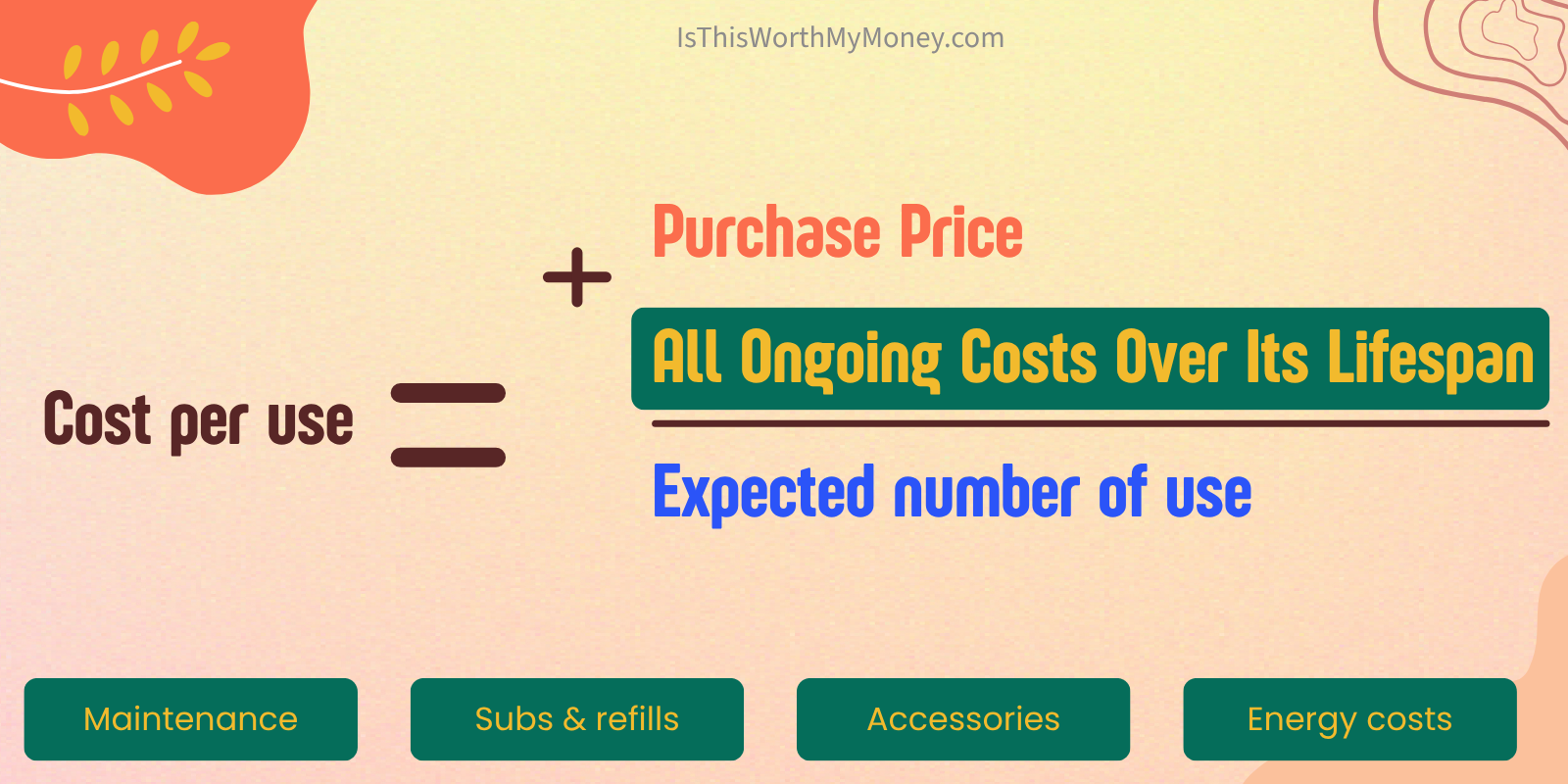
Those "ongoing costs" are what trip people up. Before you divide, make sure you're adding in:
- Maintenance and repairs, phone screen replacements, car servicing, appliance tune-ups
- Subscriptions and refills, coffee pods, app fees, filter replacements, ink cartridges
- Accessories, cases, attachments, cleaning supplies, the stuff you "need" to make it work properly
- Energy costs, a dryer or space heater adds to your electricity bill every single use
Let's see what this looks like with real numbers.
Example: A pod coffee machine.
A Nespresso machine costs about $200. Not bad, right? But Nespresso pods run about $1 each. If you drink one coffee a day, that's $365/year in pods alone. Add $30/year for descaling kits and water filters. Over 3 years, your true cost is:
$200 (machine) + $1,095 (pods) + $90 (maintenance) = $1,385 total
At one cup a day for 3 years (~1,095 cups), that's $1.26 per cup.
Compare that to $4.50 at a café, and it's a clear win, you're saving over $3 per cup. But compare it to a $30 French press and a $15/month bag of ground coffee? That's about $570 over 3 years, or roughly $0.52 per cup. The pod machine costs more than double.
Neither answer is "right." It depends on what you value. But now you can see the trade-off instead of guessing.
The 30 uses rule. Before you even reach for the calculator, here's a quick gut check: if you can't picture yourself using something at least 30 times, think very hard before buying it. That pasta maker, that juicer, that yoga mat, will you actually use it 30 times? Be honest. If the answer is "probably not," you already have your answer.
If you're looking for more tools to help with purchase decisions and budgeting, check out our roundup of the best free budget calculators in 2026.
Always Compare Against the Alternative
Cost per use on its own is just a number. It only becomes useful when you compare it against what you'd spend otherwise.
The question isn't "is $1.26/cup a lot?", it's "is $1.26/cup better or worse than what I'd pay if I didn't own this machine?"
For every purchase, ask yourself: "What would I do or spend if I didn't buy this?"
- Coffee machine vs. café vs. French press
- Robot vacuum vs. hiring a cleaner once a month vs. sweeping yourself
- Gym membership vs. running outside vs. a set of dumbbells at home
This is what makes the formula work for any item without needing to label things "essential" or "luxury." You don't need a universal threshold. The comparison against your actual alternative tells you whether this specific purchase makes financial sense for your life.
A robot vacuum at $0.27/day might sound like a lot for cleaning, until you compare it to a cleaning service at $100/month. Or it might sound unnecessary if you already enjoy sweeping for 10 minutes a day. Same item, same cost per use, completely different answer depending on the person.
Is the Upgrade Worth It?
Every purchase is really two decisions stacked on top of each other: "Do I need this at all?" and "Do I need this version of it?"
Most people skip straight to the second one. They walk into a store planning to buy a phone and walk out debating which tier of phone to get. That's how you end up overpaying, you never stopped to check whether the base version already does everything you need.
Here's how to separate those two decisions with math.
- Step 1: Calculate cost per use for the base version, the cheapest option that genuinely meets your need. Not the cheapest garbage that'll break in a month, but the entry-level product that works. This tells you whether this type of purchase is worth it at all.
- Step 2: Calculate cost per use for the version you actually want.
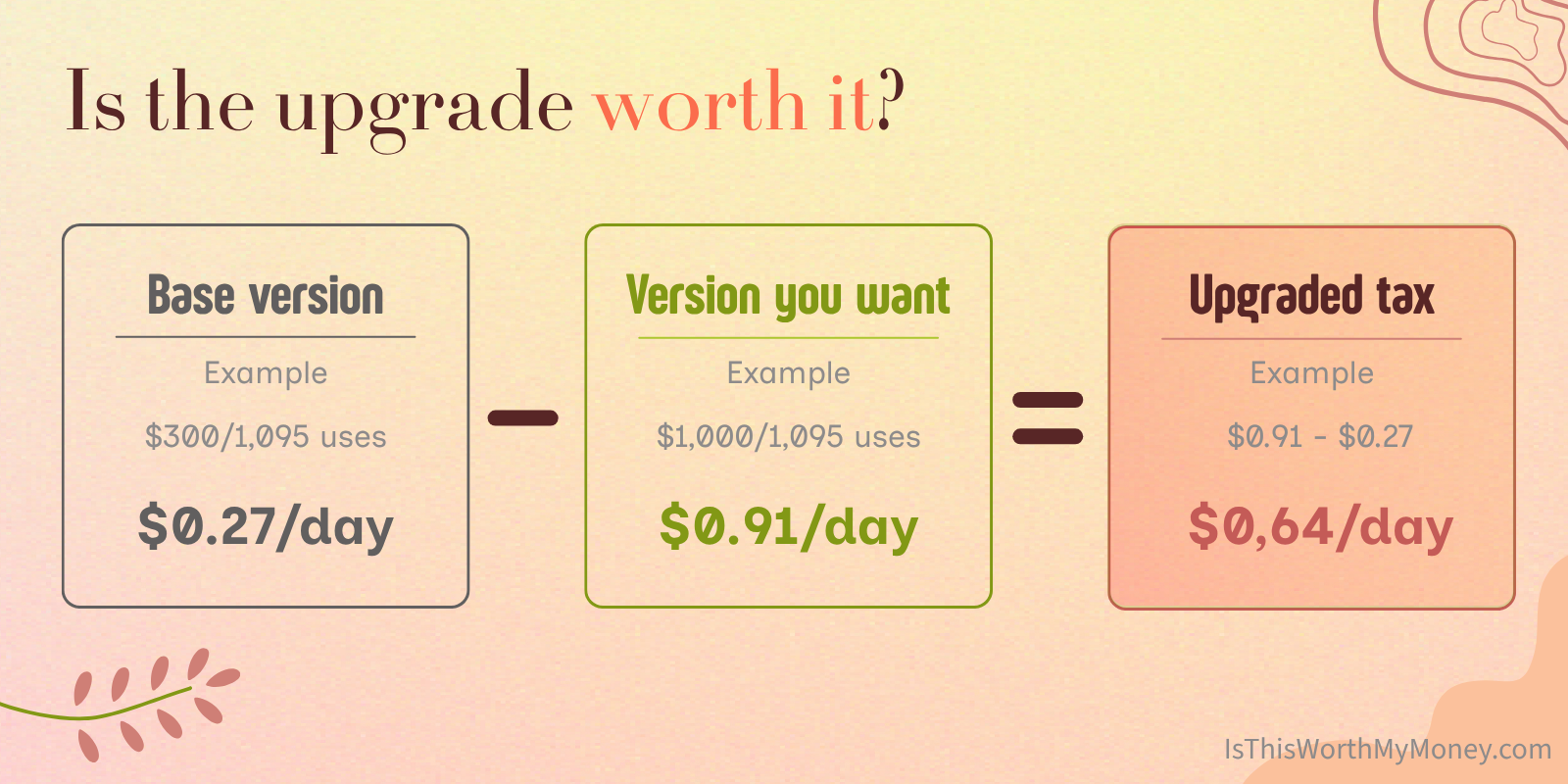
- Step 3: The gap between those two numbers is your upgrade tax per use. That's what you're paying purely for the extras, the better camera, the sleeker design, the premium features.
Worked example: A $300 Android phone vs. a $1,000 iPhone.
Both make calls, run apps, take photos. The average Android phone sells for about $300 these days, while the average iPhone runs around $800-1,000.
The base version at daily use over 3 years (~1,095 days) = ~$0.27/day.
The iPhone at the same usage = ~$0.91/day.
Your upgrade tax = $0.64/day just for the premium features, better camera, ecosystem, build quality.
Is $0.64/day worth it? That depends on two things:
- Question 1: How often will you actually use the upgrade features? Not the phone, the features that make it more expensive. You'll use the phone daily, sure. But will you use the better camera daily? If you're taking photos once a week at best, recalculate that upgrade tax based on weekly camera use, not daily phone use. Suddenly that $0.64/day becomes a lot more per actual use of the feature you're paying for.
- Question 2: Can you get the upgrade feature separately for less? Sometimes you're paying $700 extra for a better camera when a $50 clip-on lens or a free editing app gets you 80% of the way there. Or you're paying for extra storage when a $3/month cloud plan does the same thing.
The point: you don't need to label anything as "essential" or "luxury." The gap between the base cost per use and the version-you-want cost per use reveals it mathematically. A small gap means you're paying for extras you'll actually use. A huge gap means you're paying for extras you probably won't, and now you can see it clearly instead of just feeling vaguely guilty at checkout.
For a full deep dive on the phone example specifically, check out our breakdown of whether buying an iPhone is actually worth it.
The "Time Price Tag" Test
Here's a completely different way to think about purchases, one that has nothing to do with calculators or formulas.
Every item has two price tags: the dollar one and the time one. Most people only look at the first.
How to calculate yours: divide the item's price by your hourly take-home pay. The average US worker earns about $35/hour before taxes, which works out to roughly $25/hour after tax. Your number will be different, but let's use $25 as an example.
That $90 pair of shoes? It also has a "3.5 hours" price tag hanging off it. The $1,000 iPhone? That's 40 hours, a full work week of your life.
- Make it a game. Next time you're browsing online or walking through a store, mentally swap every dollar price tag for a time one. "$45 hoodie" becomes "almost 2 hours." "$200 headphones" becomes "a full day of work." It changes how things feel instantly. The dollar amount is abstract. The time is real, you can feel what 8 hours of work means.
- The shopping cart challenge. Open your Shopee, Amazon, or whatever wishlist you've been sitting on right now. Convert every saved item to hours. Add them up. That total is how long you'd need to work just to pay for your wishlist. Still want all of it? Most people find that this exercise alone cuts their wishlist in half.
- Now combine it with cost per use. That $1,000 phone costs 40 hours of work. Sounds like a lot. But spread over 3 years of daily use, each use only costs you about 2 minutes of work. Suddenly it feels completely different. A $200 kitchen gadget you'll use twice? That's still 4 hours of work per use. The time price tag works both ways.
If you're looking to get a handle on your overall spending, not just individual purchases, our 50/30/20 rule guide gives you a simple framework for splitting your income between needs, wants, and savings.
The Verdict
You don't need a finance degree to figure out if something is worth buying. You need one formula, one comparison, and a little honesty.
Cost per use, including the hidden costs, tells you what you're really paying. Comparing against the alternative tells you if that number is good or bad. The upgrade test tells you if you need the premium version or if the base one does the job. And the time price tag makes the whole thing feel real when the numbers alone don't hit home.
The goal isn't to never spend money. It's to spend it on things you'll actually use enough to justify, at the tier that makes sense for you. Some of your best purchases will be expensive ones you use every day. Some of your worst will be cheap ones you never touch.
Next time you're about to buy something, run the math. Include the hidden costs. Compare against what you'd spend without it. If the cost per use makes you wince, you have your answer. And if it doesn't? Buy it without guilt.