"Just cook at home, it's so much cheaper." You've heard it a hundred times. And it's mostly true, but "mostly" is doing a lot of work in that sentence.
Cooking at home only saves money if you actually eat what you buy, and don't value your Sunday afternoon at zero. Buy a fridge full of groceries that rot by Thursday, and your "cheap" home cooking quietly stops being cheap.
So the real question in the whole eating out vs cooking at home debate isn't "is cooking cheaper?" It's "how much cheaper, for someone with your habits?"
That number is different for a single person who eats out five nights a week than it is for a family that already meal-plans. Let's find yours.
The Quick Answer
Yes, cooking at home is cheaper, usually by a lot. A home-cooked meal runs about $4–6 per serving versus $15–20 eating out, and restaurant prices are climbing faster than grocery prices every year. For most people that's somewhere around $300–700 saved every single month.
But two hidden costs shrink that gap: food you buy and never eat, and the time cooking actually takes. Cook smart, plan, batch, use your leftovers, and the savings are real. Cook chaotically, and they quietly disappear.
Is it actually cheaper to cook at home?
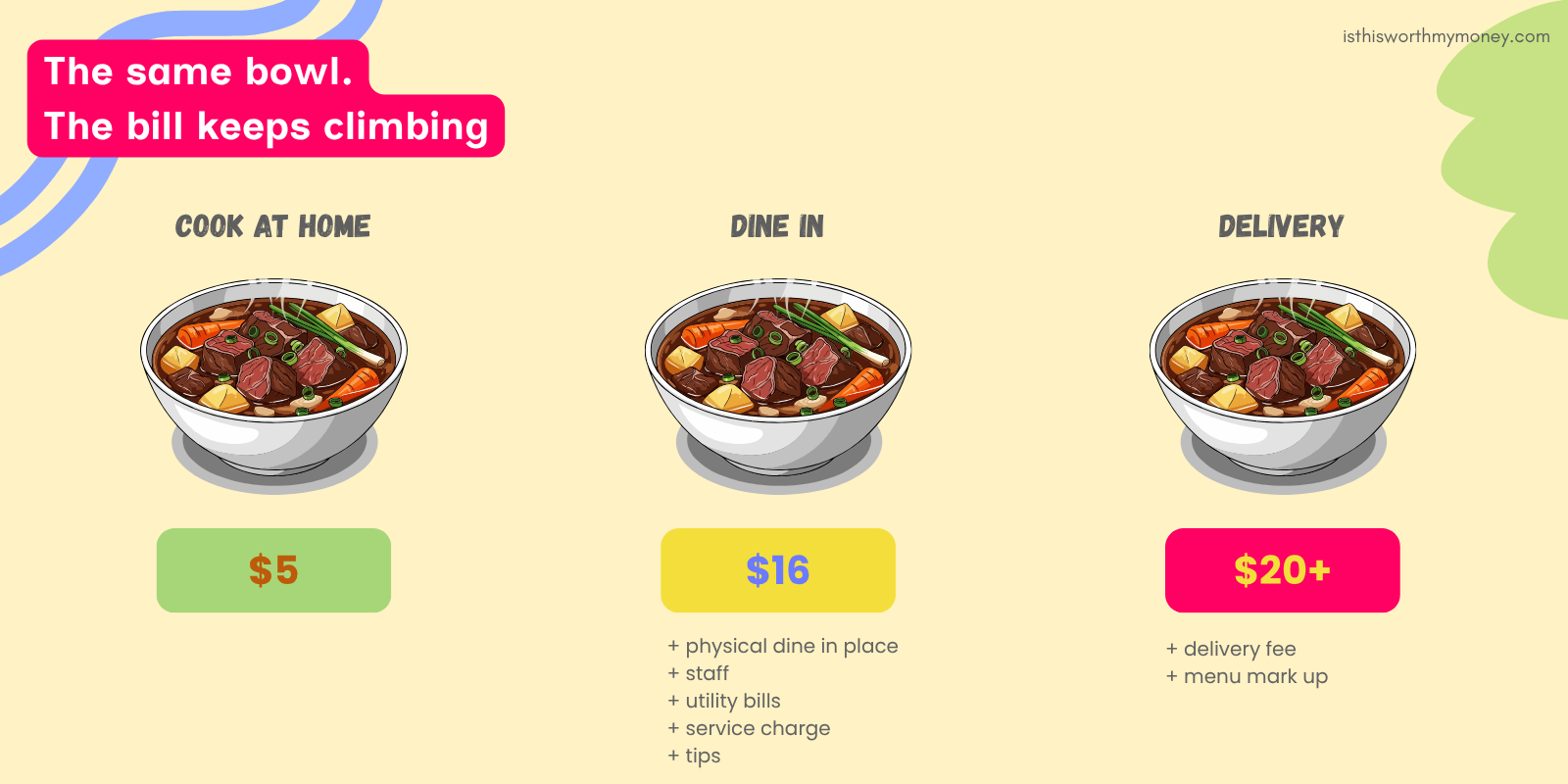
Yes, and it's not close. The same meal that costs you about $5 to make at home runs around $16 at a cheap restaurant, roughly three times more for the exact same food.
Why the gap?
Because at a restaurant, you're not just paying for ingredients. You're paying for the rent on the dining room, the staff, the electricity, the tax, and the tip. The actual food is a small slice of your bill. At home, you skip all of that and pay for the food alone.
And it gets worse the more convenient you make it. Delivery is the real budget killer, once you stack delivery fees, service charges, and the menu markup apps quietly add, you can end up paying close to five times what the same dish costs to cook yourself. That $12 bowl of noodles becomes a $20+ tap on your phone.
And guess what? The gap is widening. In 2025, grocery prices rose about 2.3% while restaurant prices jumped 3.8%, and that's been the pattern for years now. Eating out isn't just more expensive today; it's getting more expensive faster than cooking is.
It's the same quiet math behind the latte factor - a small price difference per meal doesn't feel like much, until you multiply it by every meal you eat this year.
How much can you actually save in a month?
Probably more than you'd guess, for a lot of people, $300–700 a month. The exact number depends entirely on how often you currently eat out.
Here's the simple version: If you swap just one $16 restaurant lunch for a $5 home lunch, that's $11 back in your pocket.
Do that for lunch and dinner, five days a week, and you're looking at over $400 a month without trying very hard. The savings aren't dramatic per meal, they're dramatic because there are so many meals.
Now the part that actually matters. That money isn't just "saved", it could be working for you. Put $400 a month into a basic index fund earning around 8% a year, and in ten years it grows to roughly $73,000.
You don't have to invest every dollar to feel it. Even redirecting half of it toward an emergency fund or debt changes your year. If you want a framework for where this money should go, our 50/30/20 rule guide and how much you should save each month both walk through it.
The hidden costs
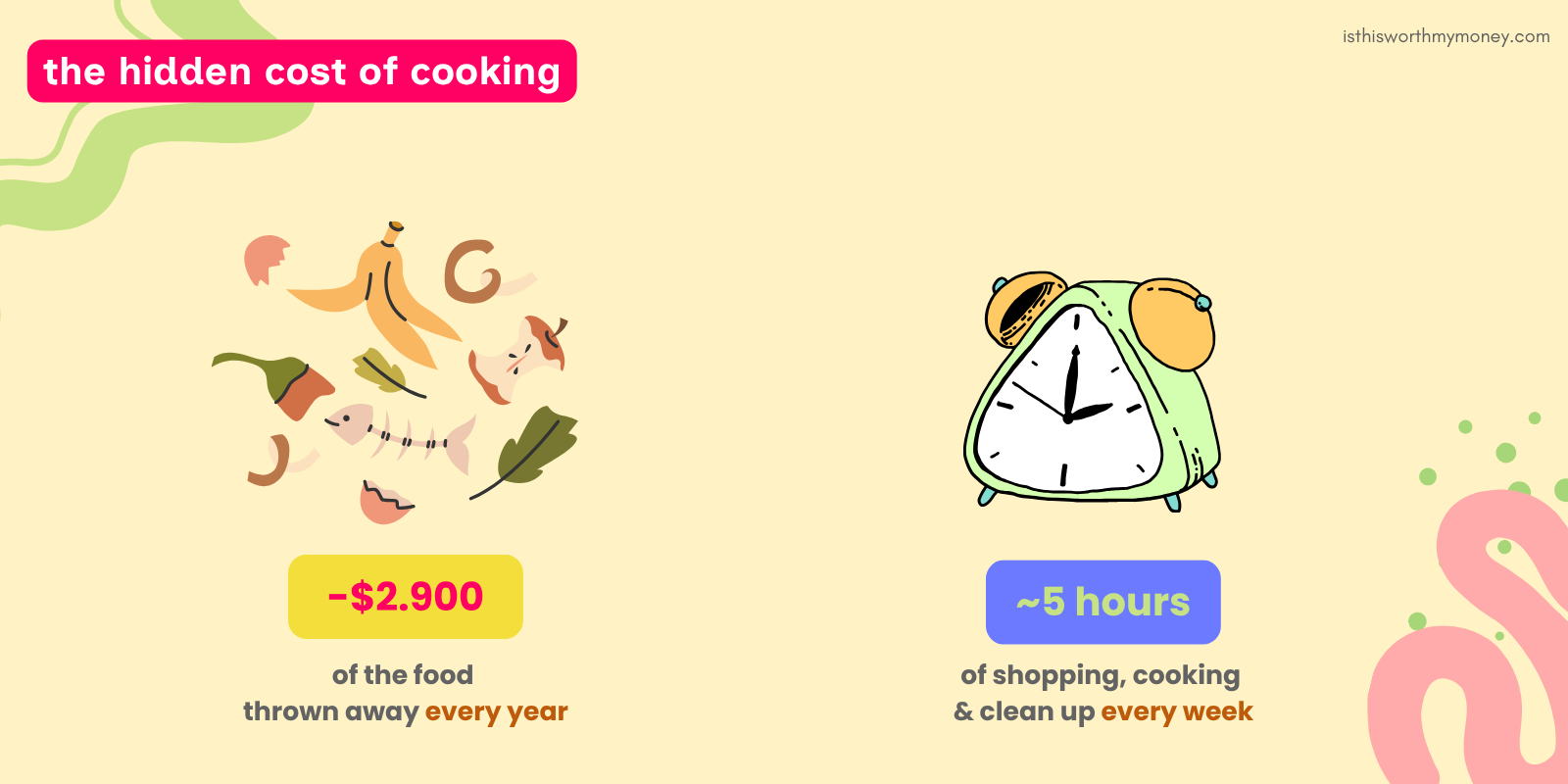
Here's where most "just cook at home" advice gets dishonest: it pretends cooking is free. It isn't. Two costs quietly eat into your savings, and ignoring them is why people swear they're cooking to save money but never see it in their bank account.
The first is food waste. The average U.S. household throws away roughly $2,900 of food a year, about $56 a week straight into the trash. That wilted spinach you bought with good intentions? It doesn't just cost you nothing, it raises the real price of every meal you did cook, because you paid for it and got zero meals out of it. The cheapest meal is the one you don't let rot in the fridge.
The second is your time. Shopping, cooking, and cleanup add up to real hours, and if you're slammed or you genuinely hate cooking, that time has value. Pretending otherwise just sets you up to feel like a failure the week you order pizza.
So what's the fix? It's not "cook vs. don't cook." It's cook smart. Plan your meals before you shop so nothing dies in the crisper drawer. Batch-cook once and eat three times, so your time-per-meal drops through the floor. That's the difference between home cooking that actually saves money and home cooking that just makes you tired. For more of these, our 11 money-saving tricks that actually work has a few that pair perfectly with a meal plan.
When is eating out actually worth it?
Sometimes it just is, and this blog isn't here to make you feel guilty about every meal you don't cook. Money is for living, not just hoarding.
Eating out earns its price when you're buying more than food. A dinner that celebrates something, a long catch-up with a friend you never see, a date night that actually matters, that's not a budget leak, that's the point of having money. Same goes for the genuinely brutal week when cooking would cost you sleep you can't spare, or that one recipe needing a $9 jar of something you'll use once and then watch expire.
The trap isn't eating out. It's eating out on autopilot. It's the third absent-minded $18 delivery of the week that you don't even remember ordering and didn't particularly enjoy. That's the spending that quietly drains your account while giving you nothing back.
So here's the rule of thumb worth remembering: cook the default, eat out on purpose. Make home cooking the easy, automatic choice, and let restaurants be a decision you actually make, not a reflex. If you want a quick gut-check for any given splurge, our guide on how to calculate if a purchase is worth it works just as well on a $60 dinner as it does on a gadget.
The Verdict
Cook at home as your default. It's cheaper, the gap is growing every year, and the savings are big enough to genuinely change your future, we're talking tens of thousands of dollars over a decade, not pocket change. On pure money, it's not really a debate.
But don't turn it into a punishment. The goal isn't to never see the inside of a restaurant again, it's to stop bleeding money on meals you don't even remember eating.
Here's the one sentence to keep: home cooking wins on cost if you don't waste food and you don't value your time at infinity. Make the cheap option the easy option, reserve eating out for when it's actually worth it, and run your own numbers above, your real gap is probably bigger than you think.
What is the 50/30/20 budgeting rule? - the framework behind most budget calculators.