44% of electric cars now cost less to own over 5 years than their gas equivalents. That means 56% still don't. The difference between landing on the right side of that split comes down to a few specific numbers: how far you drive, what you pay for electricity, and whether you charge at home. Here's the breakdown.
The Quick Answer
For most drivers who charge at home and keep the car 5+ years: yes, an electric car will save you money**.** You'll typically save $800 - $2,200 a year on fuel and maintenance combined.
But if you rely on public charging, drive under 10,000 miles a year, or plan to sell within 3 years, the higher purchase price and steeper depreciation may wipe out those savings.
The math is personal, and we'll help you run it below.
How Much Does an Electric Car Actually Cost vs. a Gas Car?
Let's start with the sticker price, because that's what scares most people off.
In 2026, the average new EV sells for about $43,500. The average new gas car? Around $37,200. That's roughly a $6,300 gap, which sounds like a lot until you realize it was nearly $15,000 just four years ago. The price difference is shrinking fast.
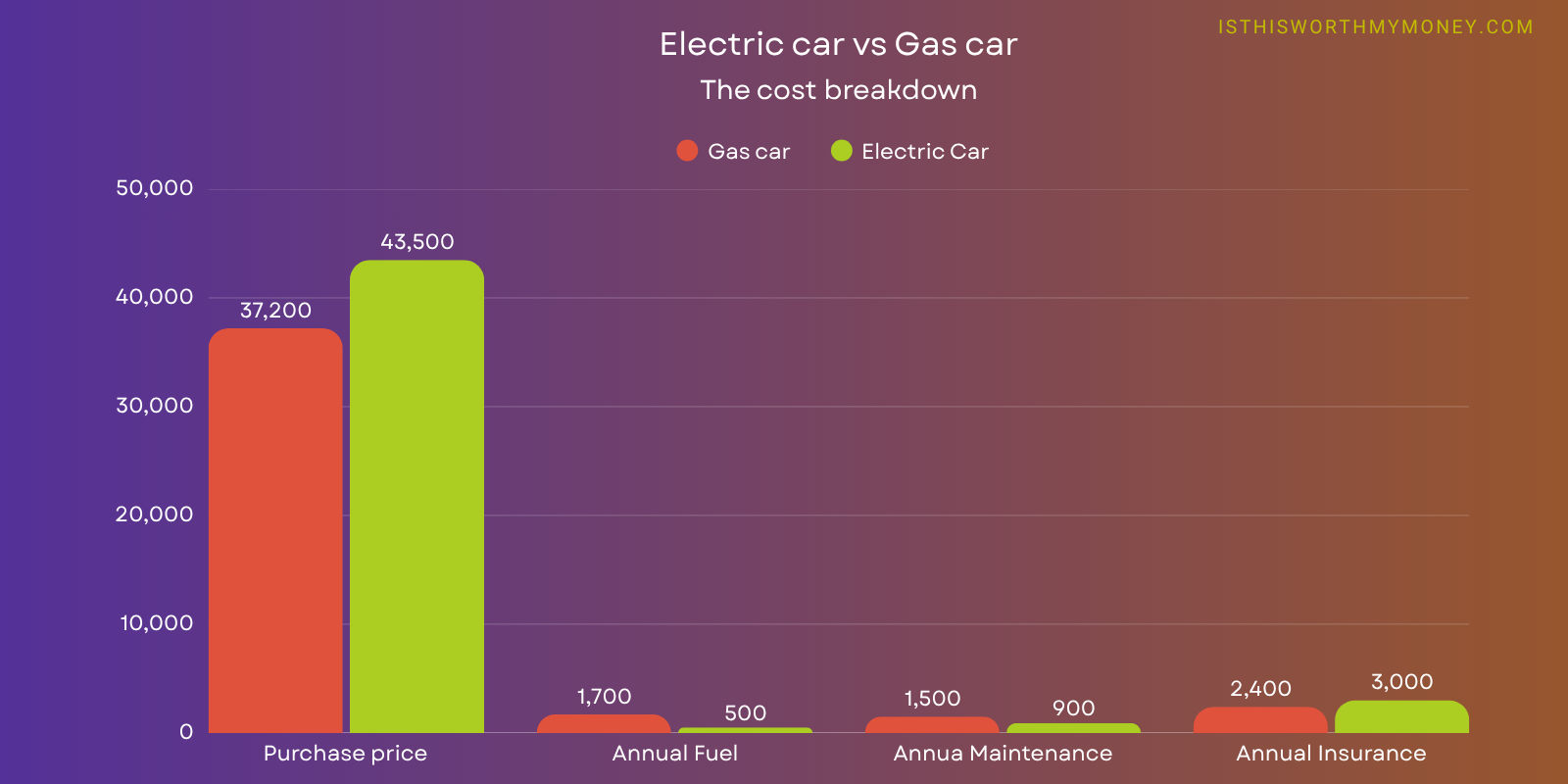
EVs cost more upfront and to insure, but save big on fuel and maintenance.
A big reason: battery costs. They've dropped almost 50% since 2023 and are heading toward $80 per kilowatt-hour in 2026. That's the magic number where EVs hit price parity with gas cars without any subsidies. We're basically there.
But if you're comparing apples to apples - say, a mid-size sedan - the gap might be smaller or larger depending on the specific models. A Chevy Equinox EV and a comparable Toyota RAV4 are closer in price than the averages suggest. The point: don't compare the average EV to the average gas car. Compare the actual two cars you're considering.
What About Used EVs?
Here's where it gets interesting. Used EVs are where the real value is hiding.
EVs depreciate steeply, about 60% over 5 years compared to 45% for gas cars. That's terrible news if you buy new. But it's amazing news if you buy used. A 3-year-old EV that originally cost $45,000 might sell for around $20,000. Someone else absorbed the depreciation hit, and you get the fuel and maintenance savings from day one.
The battery concern? Mostly overblown for used buyers. Standard warranties cover 8 - 10 years or 100,000 miles, and modern batteries are designed to last 300,000 - 500,000 miles. If the car is 3 years old with 35,000 miles, you've likely got years of warranty left and a battery that's barely broken in.
How Much Does an Electric Car Save You Per Year?
This is where EVs really shine, the day-to-day costs.
Fuel savings are the big one. An EV costs about 4 - 6 cents per mile to charge at home. A gas car runs about 10 - 13 cents per mile in fuel. For a typical driver putting on 15,000 miles a year, that's roughly $1,200 - $1,700 saved on fuel alone.
Here's what that looks like in real dollars:
- Gas car: ~$1,700/year on fuel
- Electric car: ~$500/year on electricity
- You save: ~$1,200/year
Maintenance is the other win. No oil changes. No transmission service. Brake pads last way longer thanks to regenerative braking. EVs cost about 6 cents per mile in maintenance versus 10 cents for gas cars. That's another $330 - $600 a year you're not spending.
Combined, most estimates land at $800 - $2,200 a year in total savings, depending on where you live, how much you drive, and what you pay for electricity.
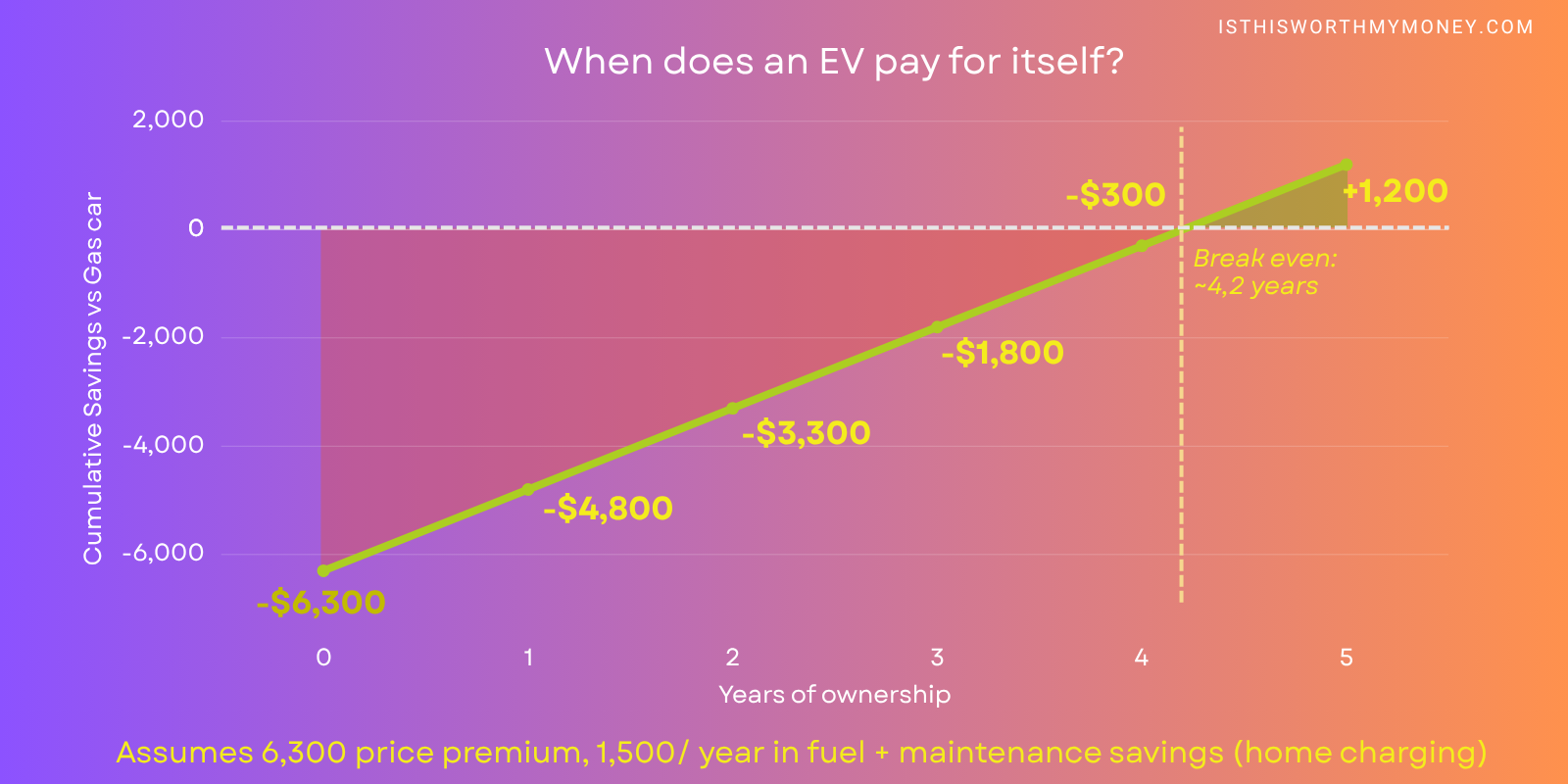
With ~$1,500/year in savings, most EV owners break even on the price premium in about 4 years.
One critical caveat: these numbers assume you charge at home. Public DC fast charging can cost 3 - 4 times more than home charging, which would cut your fuel savings roughly in half. If you don't have a garage or driveway where you can plug in, the math changes significantly.
If you're wondering how these savings fit into your overall budget, our 50/30/20 rule guide breaks down how to allocate your income, and that annual fuel savings could shift a nice chunk from "needs" to "wants."
The Hidden Costs Nobody Mentions
Fuel and maintenance savings are real. But they're not the whole story. Here are the costs that don't make the brochure.
Insurance will cost you more. EVs typically run 20 - 50% more to insure than comparable gas cars. The industry-wide average for full-coverage EV insurance is around $2,400 - $4,000 a year, though it varies wildly by model. A Chevy Bolt can actually be cheaper to insure than the national gas car average, while a Tesla Model Y might cost $400+ more per year. The reason: EVs cost more to repair when something goes wrong. Fewer shops are equipped to work on them, and battery damage assessments are expensive.
Home charger installation isn't free. A Level 2 home charger, the kind that fully charges your car overnight, runs $500 - $2,000 installed. You can skip this and use a regular wall outlet, but it's painfully slow (think 2 - 4 miles of range per hour of charging). Most EV owners say the Level 2 charger is non-negotiable.
When repairs happen, they hurt more. EVs need fewer repairs overall. But when something does break, the average EV repair costs about $1,030 more per incident than a gas car repair. Plus, there are fewer trained technicians, which means longer wait times, about 16 days in the shop versus 13 days for gas cars.
Depreciation is steeper in the early years. As we mentioned, EVs lose about 60% of their value in 5 years versus 45% for gas cars. If you're planning to sell or trade in within a few years, that's a significant financial hit. This is the same thinking we applied in our iPhone cost analysis - the sticker price isn't the real cost. You have to look at what you'll get back when you're done with it.
Let's be honest about these costs: they're real, but they don't all hit every owner. The insurance premium? Yeah, that's unavoidable. The battery replacement? Probably never going to happen to you.
Do EV Batteries Really Need Replacing?
Short answer: almost certainly not during your ownership.
Modern EV batteries are designed for 300,000 - 500,000 miles. The 8 - 10 year warranty covering 100,000 miles is the floor, not the ceiling. Degradation is gradual, expect about 10 - 20% range loss over 8 years, not a sudden cliff where your battery dies.
The $10,000 - $20,000 replacement cost you see in headlines? That's a worst-case scenario for out-of-warranty situations. For the vast majority of EV owners, the battery will outlast the car.
The one exception: if you're buying a used EV with no remaining warranty, get the battery health checked. That's worth the peace of mind.
What About Tax Credits and Government Incentives?
Incentives can dramatically shift the math on an EV purchase. But the landscape changed in late 2025, so here's what's actually available now.
In the US: The federal $7,500 new EV tax credit and $4,000 used EV credit expired on September 30, 2025. What replaced them is different, there's now a car loan interest deduction of up to $10,000 per year for US-assembled vehicles, available through 2028. It's not as flashy as a one-time $7,500 credit, but for a financed purchase, it can add up to significant savings over several years. There's also a home charger credit (30% of cost, up to $1,000) available until June 30, 2026.
State incentives are still going strong. Colorado offers up to $5,000, New Jersey up to $4,000 plus sales tax exemption, Massachusetts up to $3,500, and New York up to $2,000 at point of sale. Always check your state, the DOE's AFDC database is the best place to look.
In Europe: Incentives are expanding. Germany launched a new program with income-based subsidies of up to $6,000 per vehicle. France offers up to $5,700 depending on income. Italy provides up to $6,000 with a scrappage trade-in, or $4,000 without.
The key takeaway: Don't buy an EV because of incentives, buy it if the math works without them, and treat incentives as a bonus. Programs change, funding runs out, and eligibility rules are complex. If the car makes financial sense on its own merits, any incentive is just gravy.
The Verdict: Is It Worth Your Money?
After crunching all the numbers, here's where we land.
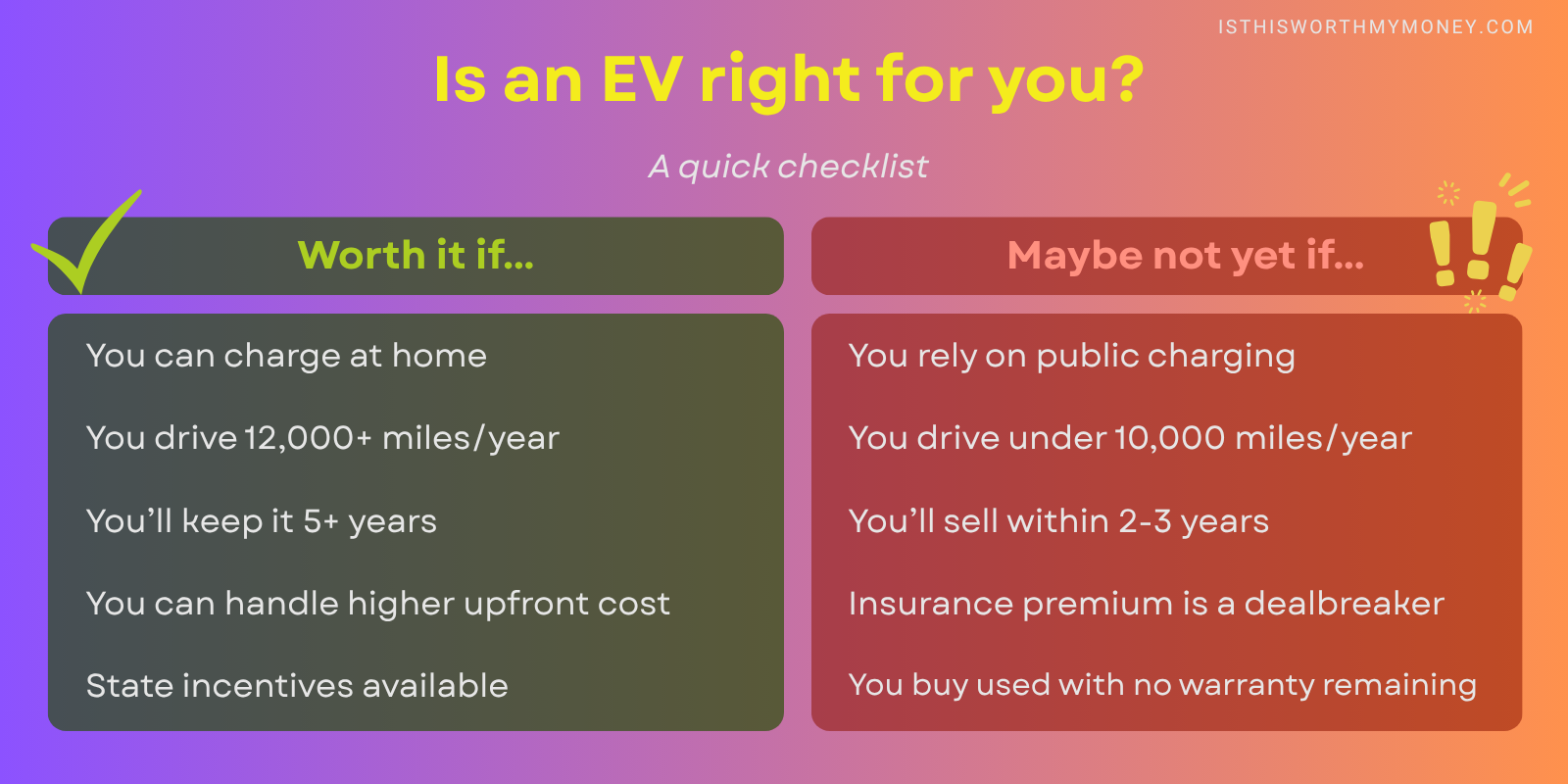
Quick checklist: where do you fall?
Yes, it's worth it if: You charge at home, drive 12,000+ miles a year, plan to keep the car for at least 5 years, and can handle the higher upfront cost. In that scenario, you'll likely save $6,000 - $15,000 over the life of the car.
Not yet, if: You rely on public charging, drive very little, plan to sell within 2 - 3 years, or the higher insurance premiums wipe out your fuel savings. In that case, a fuel-efficient gas car or a hybrid might be the smarter money move right now.
The used EV sweet spot: If the new EV price tag is too steep, a 3 - 5 year old EV is where the real value lives. Someone else absorbed the depreciation, the battery warranty likely still has years left, and you get the fuel and maintenance savings from day one.
2026 is a turning point. Battery prices are hitting the parity threshold. More affordable models are arriving. Charging networks are expanding. If you've been on the fence, the math is better than it's ever been, but it's still not universal.
Run the numbers for your situation using our calculator above. The answer isn't "EVs are worth it", it's "is this EV worth it for you."