You've heard "make a budget" and "track your expenses" a thousand times. Cool. Groundbreaking. Here's the thing though: most people already know they should spend less. The problem isn't knowledge, it's behavior. So instead of the same recycled advice, here are 11 genuinely unusual tricks that work because they hack the way your brain actually makes spending decisions. Here's the cheat sheet before we dive in:
| # | Trick | ⚡ Effort | 💰 Impact | ⏱ Speed |
|---|---|---|---|---|
| 1 | The 10-Minute Rule | Low | Medium | Instant |
| 2 | Pay With Cash | Medium | High | Days |
| 3 | Shop Full + Set a Timer | Low | Medium | Instant |
| 4 | Cost Per Use Math | Low | High | Instant |
| 5 | The Stranger Test | Low | Medium | Instant |
| 6 | No-Spend Challenge Days | Medium | High | Days |
| 7 | Delete Saved Payment Info | Low | High | Instant |
| 8 | The 72-Hour Rule | Low | High | Days |
| 9 | Pretend Price Increases | Medium | High | Weeks |
| 10 | Buy in the Wrong Season | Low | High | Weeks |
| 11 | One In, One Out | Low | Medium | Instant |
1. The 10-Minute Rule
⚡ Effort: Low | 💰 Impact: Medium | ⏱ Speed: Instant
Next time you want to buy something unplanned, set a timer for 10 minutes. Walk away. Browse another aisle. Scroll to a different app. You'll be surprised how many "must-haves" suddenly feel like "meh, maybe not" after just 10 minutes. Impulse purchases rely on urgency, and this tiny pause breaks the spell.
2. Pay With Cash (Physically)
⚡ Effort: Medium | 💰 Impact: High | ⏱ Speed: Days
Research shows people spend 12-18% less when paying with physical cash compared to cards. There's a real psychological concept behind this called the "pain of paying." Handing over paper bills feels like losing something. Tapping a card? Feels like nothing. Try withdrawing a fixed weekly budget in cash for things like groceries, eating out, and random purchases. When the cash is gone, you're done for the week.
3. Shop When You're Full and Set a Timer
⚡ Effort: Low | 💰 Impact: Medium | ⏱ Speed: Instant
Everyone says "don't shop hungry." OK sure. But the real hack is pairing a full stomach with a 30-minute time limit. Give yourself exactly half an hour in the store. When you're racing the clock, you stick to what you came for. No wandering. No "oh this looks interesting." Speed kills impulse buys.
4. The "Cost Per Use" Mental Trick
⚡ Effort: Low | 💰 Impact: High | ⏱ Speed: Instant
Before buying anything, do quick math: divide the price by how many times you'll realistically use it.
A $200 jacket you wear 200 times? That's $1 per wear. Great deal. A $50 trendy top you wear 3 times before it sits in the back of your closet? That's $16.67 per wear. The "cheap" item is actually the expensive one.
This one mental shift completely changes how you see prices. It makes quality purchases feel smarter and impulse buys feel wasteful, because they are.
See how much time you need to work to afford the item:
5. The Stranger Test
⚡ Effort: Low | 💰 Impact: Medium | ⏱ Speed: Instant
Picture this: a stranger walks up and offers you the item you're about to buy, OR the exact amount of cash it costs. Which one do you take?
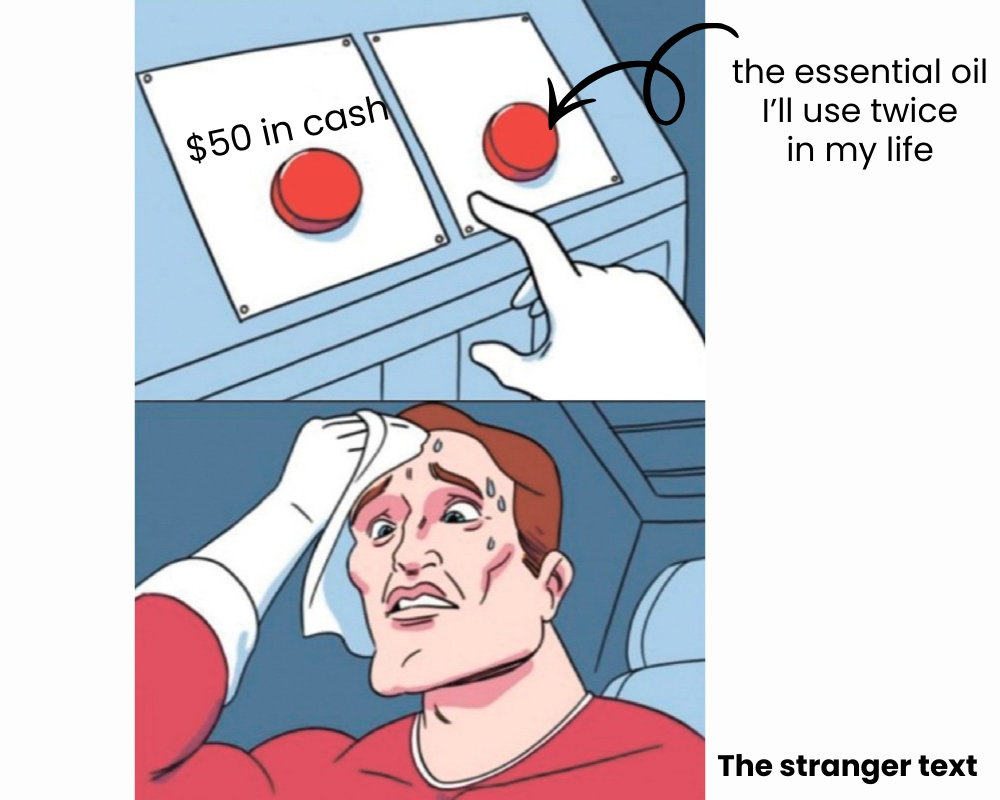
Be honest. If you'd grab the cash (and most of the time, you would), then you don't really want the item that badly. You just got caught up in the excitement of buying. This takes about 3 seconds to do and it's surprisingly effective at separating real wants from shopping autopilot.
6. No-Spend Challenge Days
⚡ Effort: Medium | 💰 Impact: High | ⏱ Speed: Days
Full "no-spend months" are brutal and most people quit by day 4. Instead, try something manageable. Pick 2-3 days a week where you simply don't spend anything. No coffee runs. No online orders. No "just this one thing."
Make it a game. Track your streak. Challenge a friend. Tuesdays and Thursdays work great because they're boring enough that you won't feel like you're missing out. It adds up way faster than you'd think.
7. Delete Saved Payment Info Everywhere
⚡ Effort: Low | 💰 Impact: High | ⏱ Speed: Instant
This is a one-time setup that pays off forever. Go to every shopping app and website you use and remove your saved card details. Now every time you want to buy something online, you have to get up, find your wallet, and type in 16 digits plus the expiration date plus the security code.
That small amount of friction is enough to kill a huge chunk of impulse purchases. If you're too lazy to type your card number, you didn't want it badly enough.
8. The 72-Hour Rule for Anything Over $50
⚡ Effort: Low | 💰 Impact: High | ⏱ Speed: Days
Simple rule: if something costs more than $50, you wait 3 full days before buying. No exceptions.
After 72 hours, one of two things happens. Either you completely forgot about it (which means you never needed it), or you still want it and can clearly explain why. In the second case, go ahead and buy it guilt-free. You've earned it. Most of the time though? You'll forget.
Adjust the dollar amount to whatever makes sense for your budget. The point is creating a mandatory cooling-off period for purchases that actually dent your wallet.
9. "Pretend" Price Increases
⚡ Effort: Medium | 💰 Impact: High | ⏱ Speed: Weeks
Tell yourself your rent just went up by $200 a month. Then set up an automatic transfer of $200 to your savings account on the same day rent is due.
Here's why this works: humans are incredibly good at adapting to new normals. Within 3-4 weeks, your brain adjusts to having $200 less in your checking account, and you naturally spend less everywhere else to compensate. You barely feel it, but your savings grow fast.
Pick whatever number makes sense for your income. Even $50 a month is $600 a year you wouldn't have saved otherwise.
10. Buy in the Wrong Season
⚡ Effort: Low | 💰 Impact: High | ⏱ Speed: Weeks
Winter coats in March. Swimsuits in October. Holiday decorations in January. Patio furniture in September.
Retailers need to clear out seasonal inventory, and the discounts are massive. We're talking 40-70% off on stuff that's identical to what you'll see at full price 6 months later. This isn't groundbreaking advice, but almost nobody actually does it because it requires thinking ahead. Be the person who thinks ahead.
11. The "One In, One Out" Rule
⚡ Effort: Low | 💰 Impact: Medium | ⏱ Speed: Instant
Every time you buy something new, something you already own has to go. New pair of shoes? An old pair gets donated. New kitchen gadget? One leaves the drawer.
This rule doesn't directly save money, but it does something sneaky: it forces you to mentally attach a "cost" to every purchase beyond just the price tag. Suddenly buying that 4th pair of nearly identical sneakers feels a lot less appealing when you have to give up one of the pairs you already love.
Pick 2-3 and Start This Week
You don't need to do all 11. That's a recipe for burnout. Instead, pick 2 or 3 that feel doable right now. The ones rated "Low Effort" and "Instant Speed" are great starting points because they work immediately and cost you nothing but a tiny mental shift.
Once those feel natural, add another one. Small stacks of good habits beat one massive overhaul every time.
Try our Worth It Calculator to plug in your own numbers and find out whether you need to start managing your budget from today!