A glance at the answer
Yes, China is much cheaper in dollars. Essential bills for one adult run about $540 a month in China vs $2,300 in the US. But pay is lower too, so the real answer depends on who signs your paycheck. An urban Chinese worker on the official average wage keeps 59% of take-home pay after bills. The average American keeps 50%, or 36% if they drive.
How we compared:
- One adult, full-time job, renting a 1-bedroom alone.
- Take-home pay is after tax and payroll deductions.
- Prices are national averages, converted at the ECB rate on 19 October 2026 (1 USD = 6.68 yuan).
- Health insurance only counts when you pay it on top of your salary.
How much do people earn in China vs the US?
The average American takes home about 3.5 times more than the average urban Chinese worker. And China has two very different "average" salaries.
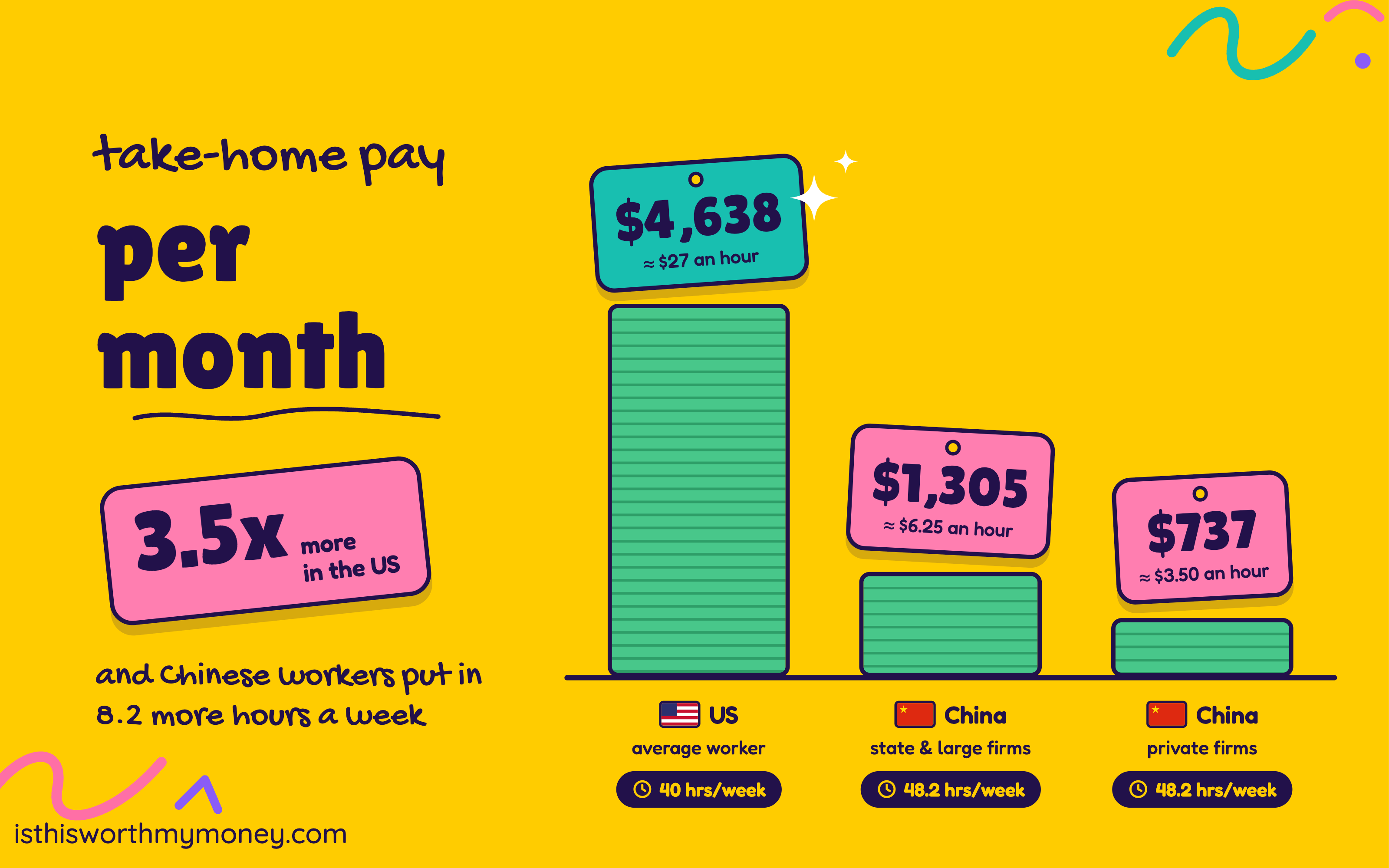
China's statistics bureau reports wages separately for "non-private units" (state-owned companies, government and larger firms) and private companies. The headline figure most news sites quote is the first one. Private-sector workers earn about 45% less.
Two more things cut into a Chinese paycheck:
- Deductions: 10.5% goes to pension, medical and unemployment insurance. Another 5-12% goes to a housing fund, a forced savings account you can only use for buying or renting a home.
- Longer weeks: Chinese company employees average 48.2 hours a week, so hourly pay is even lower than the monthly gap suggests.
Location matters too. Workers in eastern China earn about 46% more than workers in central China.
How much is rent in China vs the US?
A 1-bedroom outside the city center costs $1,339 in the US and $236 in China. As a share of pay, China wins, unless you work in the private sector.
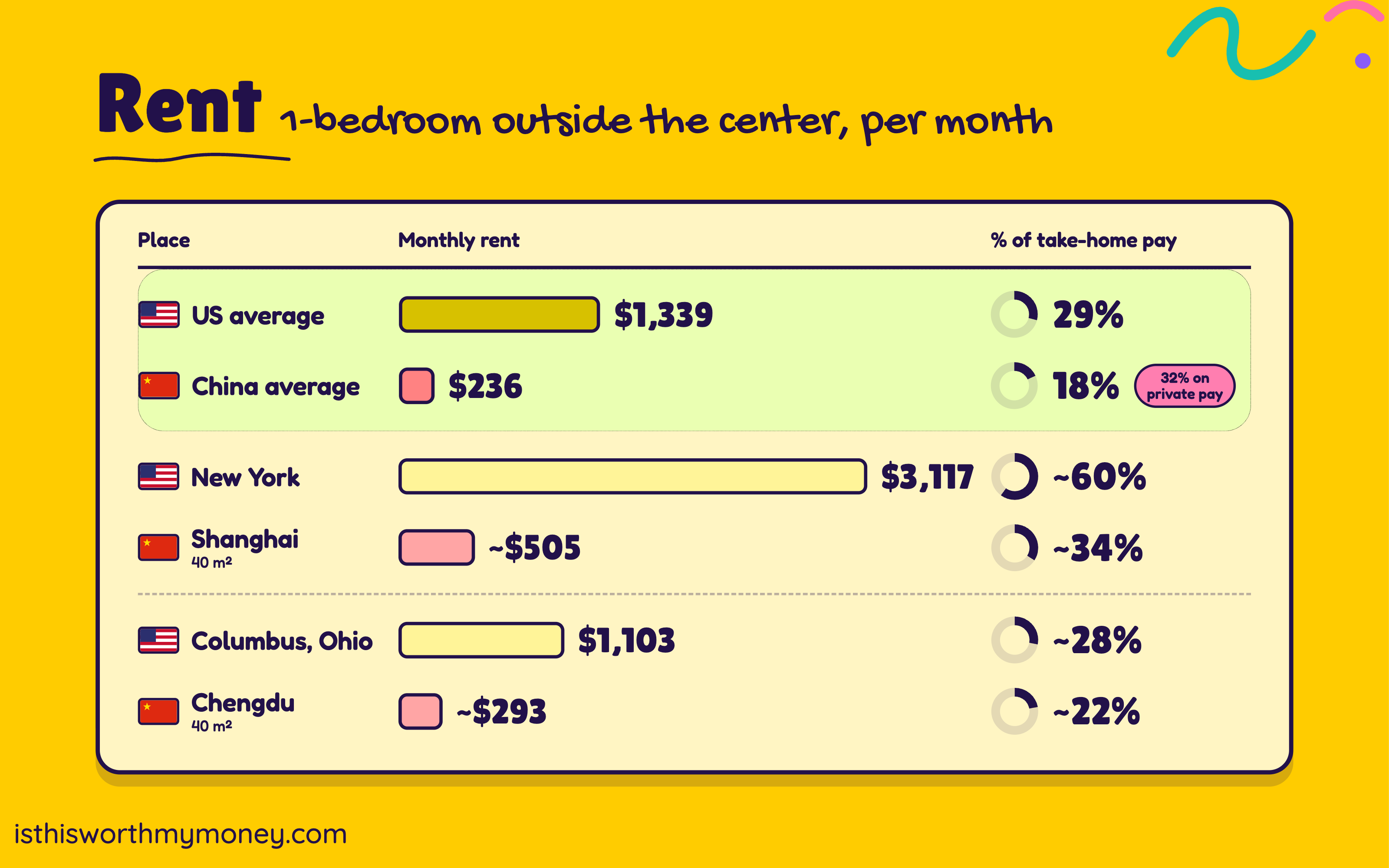
- Shanghai is the outlier. Its rent per square meter is about 2.5 times the average of 50 major Chinese cities, and it rose six months in a row in 2026 while the national average fell. That’s why a shared room (2,000-2,500 yuan, or $300-375) is the norm for young workers there.
- The US has its own squeeze. 49% of American renter households now spend more than 30% of their income on housing, a record high. If you're wondering what a healthy share looks like, the 50/30/20 rule caps all your needs, rent included, at 50% of take-home pay.
How much are monthly bills in China vs the US?
Utilities, phone and internet cost about $70 a month in China vs $350 in the US. China wins almost every line, with one surprise.
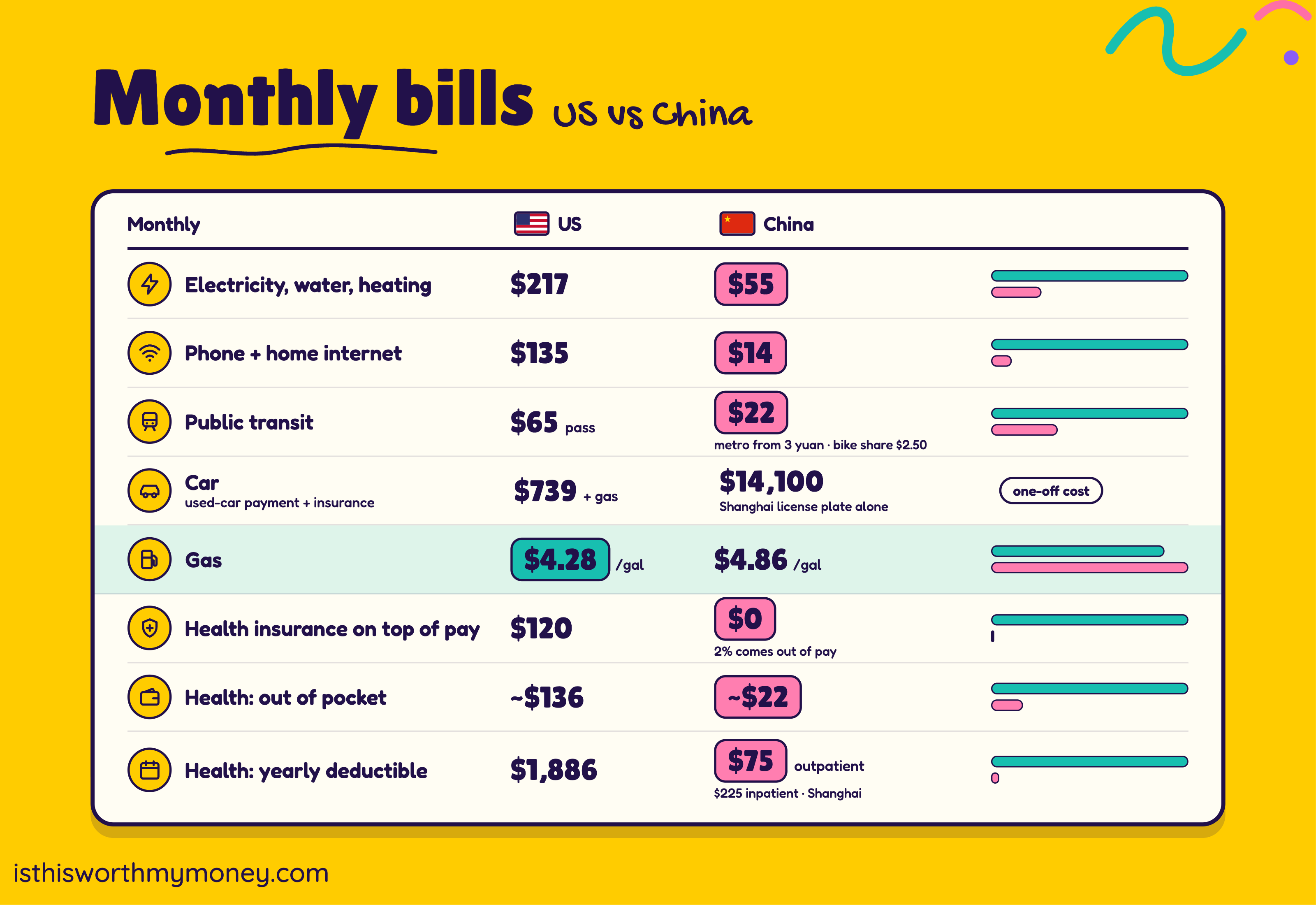
- Gas is the one thing that costs more in China. 92-octane petrol in Shanghai is 8.57 yuan a liter, which works out to about $4.86 a gallon.
- Owning a car in Shanghai starts with an auction. The average winning bid for a license plate was 94,368 yuan ($14,100) in May 2026, and only 11.5% of bidders got one. That's before you buy the actual car.
- American drivers pay for the privilege too. Only 8% of US households go without a car, and the average used-car payment plus full insurance comes to $739 a month. That's more than half of average rent, before a single gallon of gas. If you're weighing that bill, see whether an electric car is worth it.
- Healthcare hides costs in different places. American employers quietly pay about 85% of the premium, and you still face a $1,886 deductible before most coverage starts. In Shanghai, the outpatient deductible is 500 yuan ($75) a year, then insurance covers 70-80%. But Chinese patients still pay about 27% of all health spending out of their own pockets.
How much do groceries cost in China vs the US?
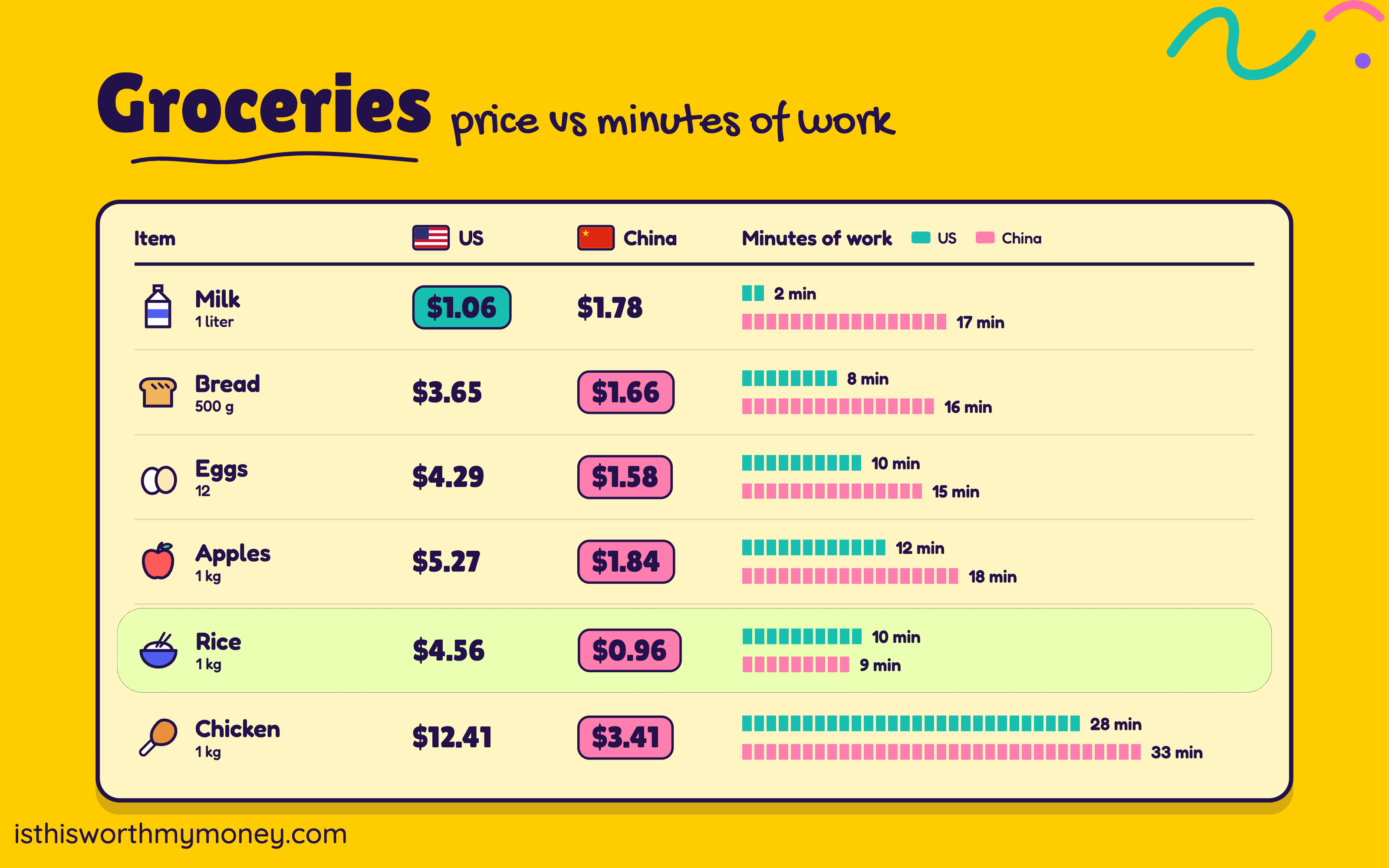
Groceries are much cheaper in China in dollars. Measured in minutes of work, they cost more on almost everything.
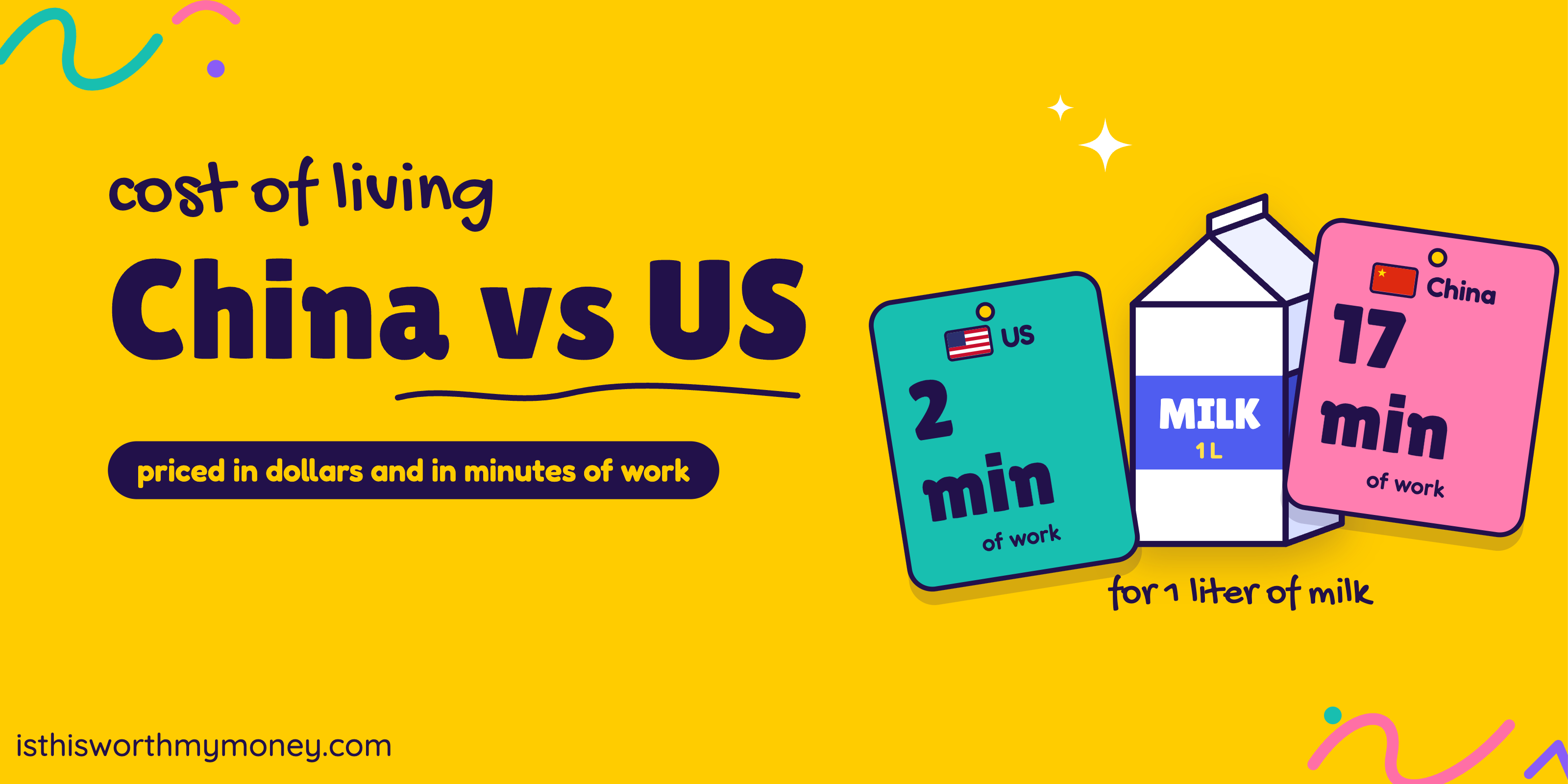
Milk takes 2 minutes of work in the US and 17 in China. Rice is the only item where China comes out ahead.
Two prices are moving fast in China right now:
- Pork is cheap. Live hog prices fell to their lowest level since 2019 this year.
- Eggs went the other way, up 14% in a year (September 2026).
What's left after the bills?
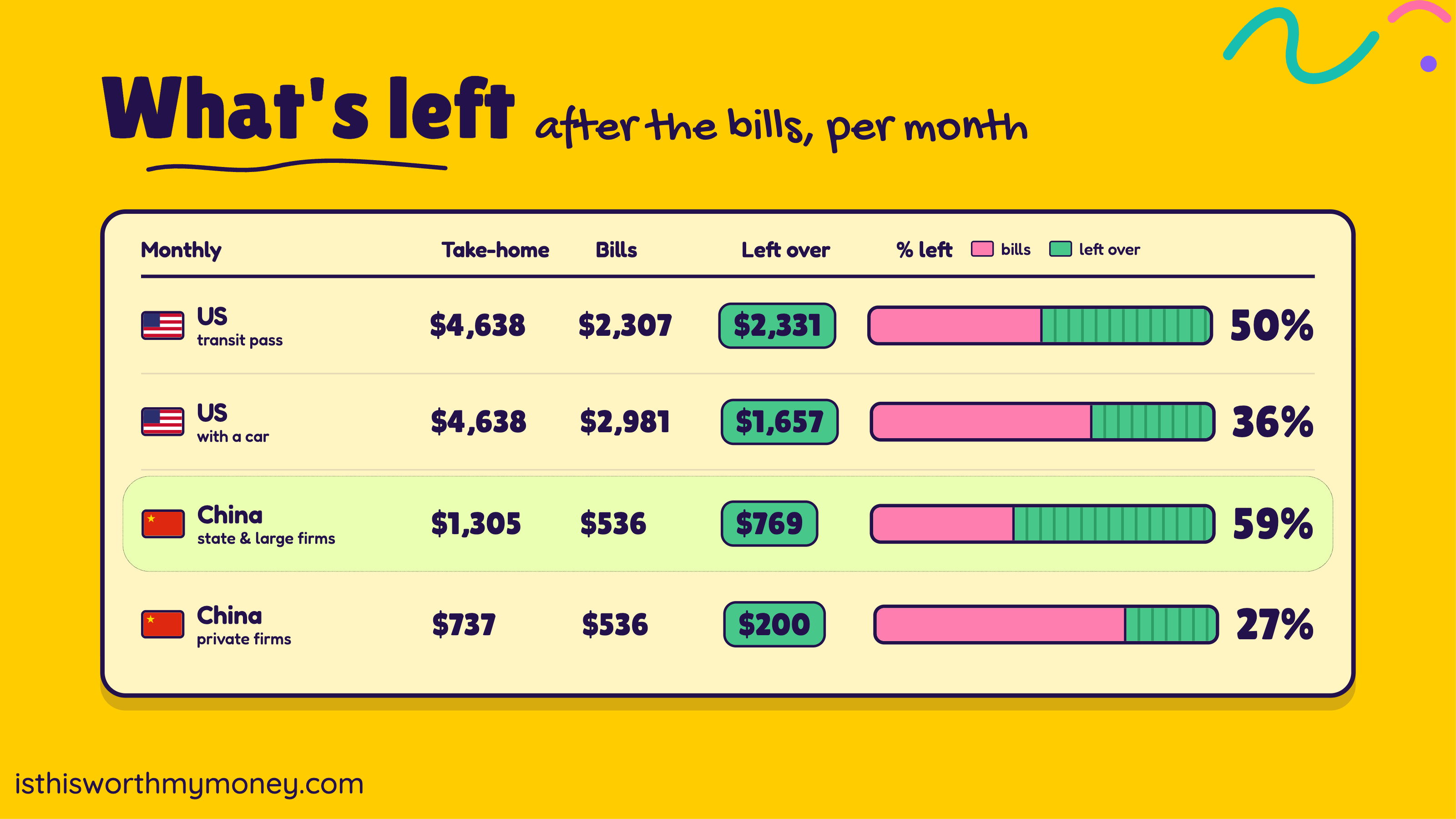
The US keeps the most dollars. China's urban average worker keeps the biggest share. China's private-sector worker keeps the least.
An urban Chinese worker on the average wage keeps 59% of take-home pay. A private-sector worker keeps 27%.
What about everything else?
Eating out, coffee, clothes and the gym all come out of that “left over” money, and this is where China and the US split in a surprising way.
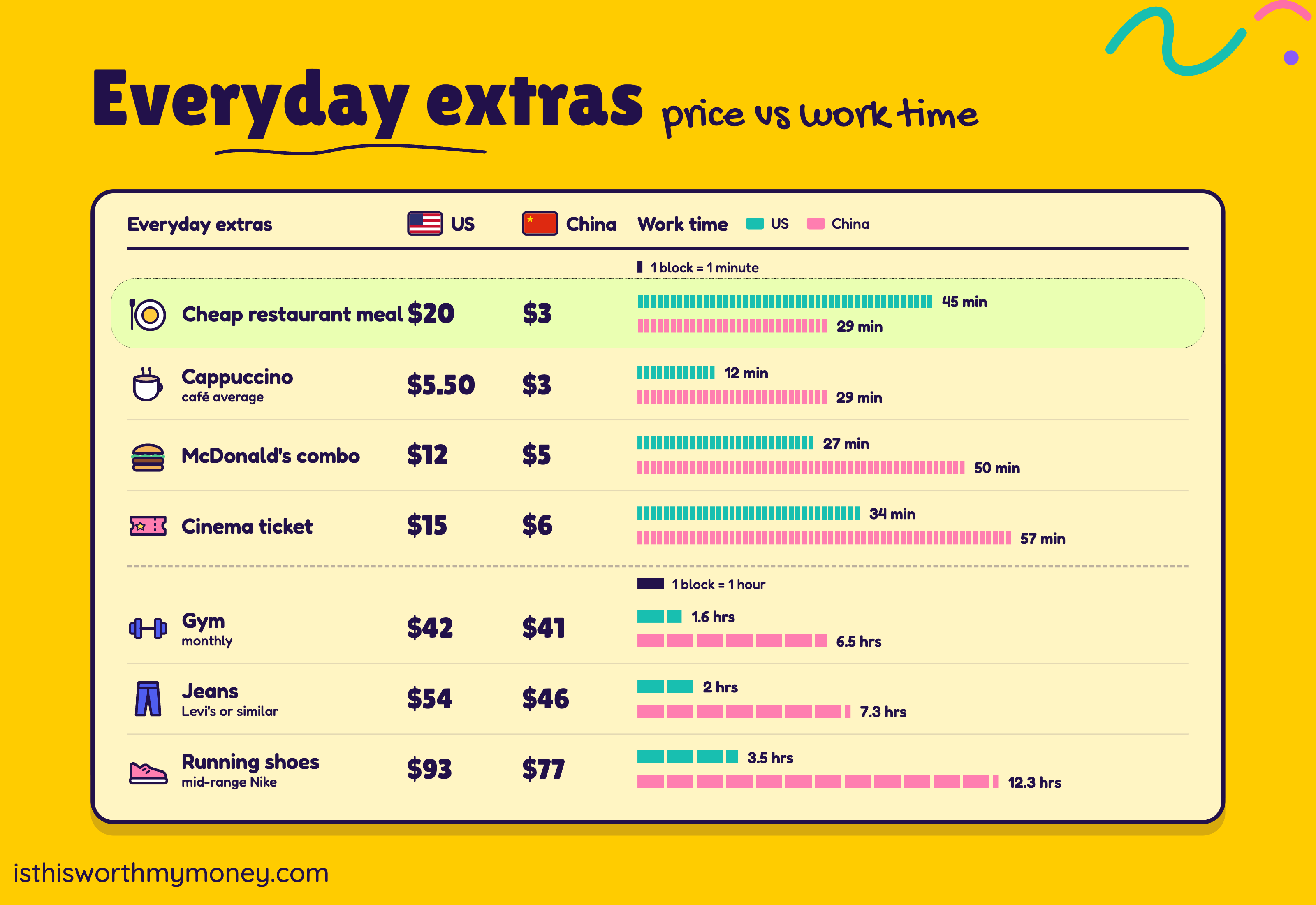
Local is cheap, global is expensive. A basic Chinese restaurant meal costs less work time than a cheap meal in the US. But anything with a global price tag (coffee, fast food, brands, the gym) costs about the same in dollars in both countries. On a Chinese paycheck, that means two to four times more hours of work.
So how much do people actually save?
“Left over” isn’t the same as “saved.” Here’s what people really keep:
- US: about 4% of income (BEA, August 2026). One-person households spend about $4,070 a month in total, close to 90% of average take-home pay.
- Urban China: about 36.5%. Urban residents spend 35,869 yuan a year out of 56,502 yuan of disposable income (NBS, 2025). Household deposits grew nearly 10% in 2025.
These are national averages, including homeowners and retirees, and money put toward buying a home counts as savings. A young renter in Shanghai likely saves less. Still, China’s real advantage isn’t just cheaper bills. Chinese households spend far less of what’s left.
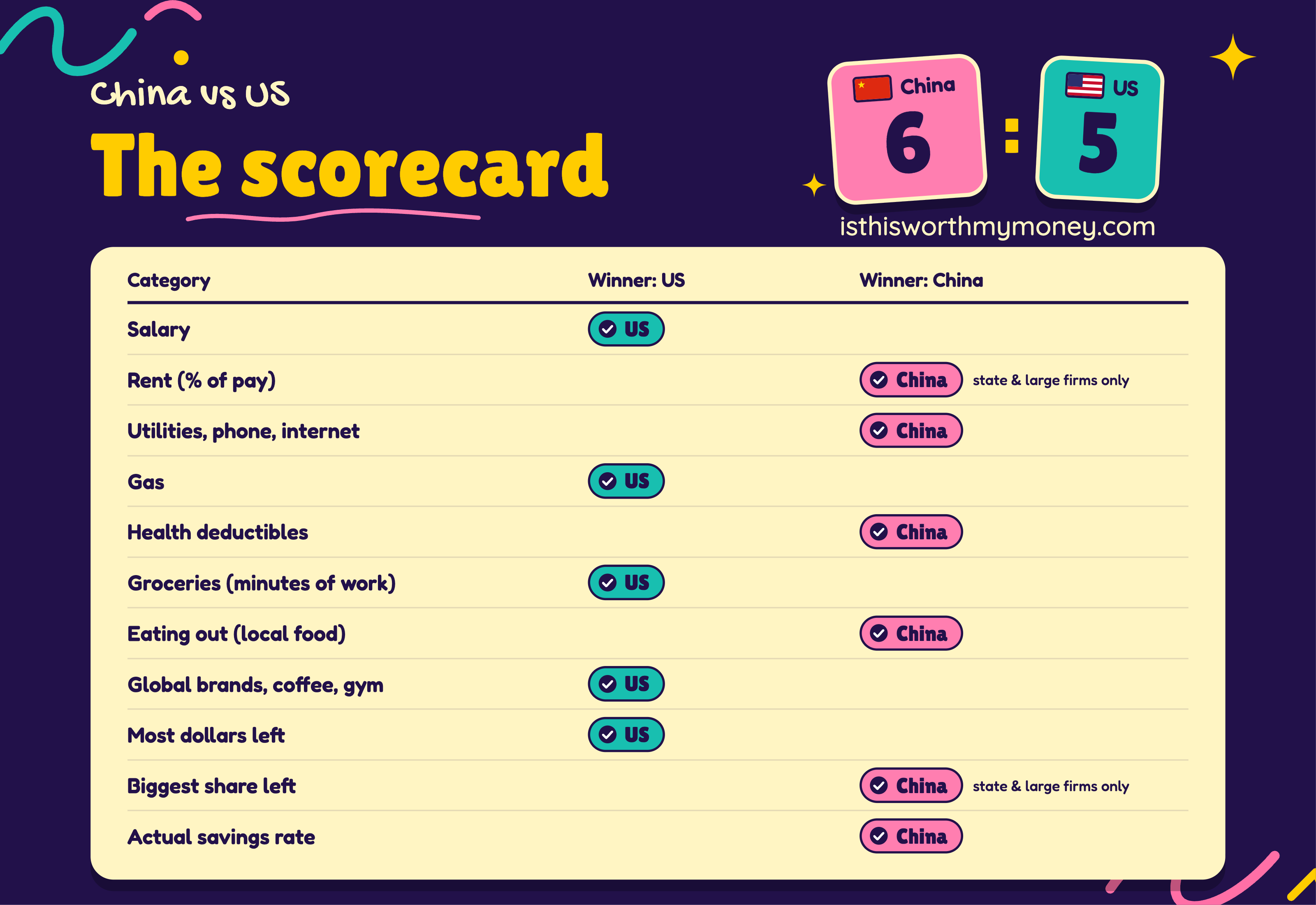
China is cheaper than the US on almost everything you pay for in dollars, except gas and owning a car. Measured against local pay, it comes down to your employer. A worker at a Chinese state-owned or large company keeps more of their paycheck than the average American. A private-sector worker keeps about a quarter, and pays more work time for food. If you're moving to China on a foreign salary, it's a bargain. If you're earning local private-sector pay, it's tighter than the price tags suggest.
Try It Yourself
Enter your take-home pay and monthly bills to see what you keep, and which row in the table above you're closest to.
Sources
Numbeo: China · Numbeo: United States · Numbeo: New York · Numbeo: Columbus · OECD Taxing Wages 2026 · NBS 2025 wages · NBS regional wages · NBS working hours · NBS CPI, Sep 2026 · NBS 2025 spending · China Index Academy rents · Shanghai youth rentals · Chengdu rents · Harvard JCHS 2026 · C114: mobile spend · C114: broadband · Autohome: Shanghai fuel · EIA gas prices · Shanghai plate auction · Experian auto finance · NerdWallet car insurance · KFF 2025 · CMS health spending · China health spending · Shanghai medical insurance 2026 · Mysteel hog prices · ECB exchange rates · BEA personal saving rate, Aug 2026 · BLS one-person household spending · Yicai: household deposits 2025 · Xinhua: 2026 movie ticket price · Shanghai 2025 average wage
Budget breakdown for a remote worker - the framework behind most budget calculators.