At the average US saving rate of 4.1%, about $190 a month, a single adult reaches $2,000 in 11 months and three months of essential bills in 35. To build an emergency fund from scratch, start with that first $2,000: people who had it were 43 points less likely to cash out their 401(k) when they left a job.
A glance at the answer
Build it in three stages: $500, $2,000, then three months of essential bills. Saving $190 a month, you reach them in 3, 11 and 35 months. Saving 10% of take home pay ($464 a month), it's 2, 5 and 15 months.
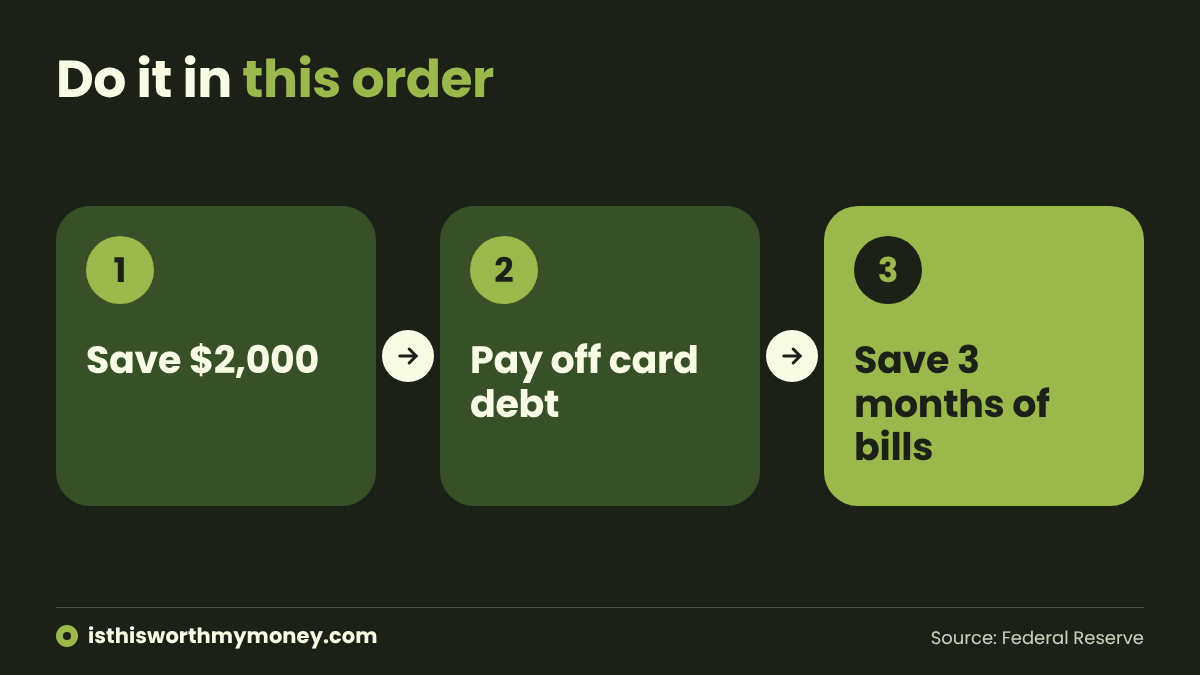
Order matters: get the $2,000 starter fund first, then pay off high interest debt, then finish the three months. Keep the money in a separate high yield savings account, and when you use it, refill it before anything else.
How we worked out the numbers
- A single US adult with no car: take home pay of $4,638 a month (OECD Taxing Wages 2026) and essential bills of $2,307 a month for rent, utilities, phone and internet, transit, food and health (the blog's US baseline, October 2026).
- Monthly saving of $190.16: the US personal saving rate of 4.1% (BEA, August 2026) applied to that take home pay.
- Monthly deposits earning 4.00% APY, compounded monthly, with months rounded up. Rates are from October 2026. The card APR is the Federal Reserve's G.19 rate for accounts charged interest (August 2026).
- Outside the US? Every milestone is also shown in months of essentials, so multiply by your own monthly bills.
How much should your first emergency fund be?
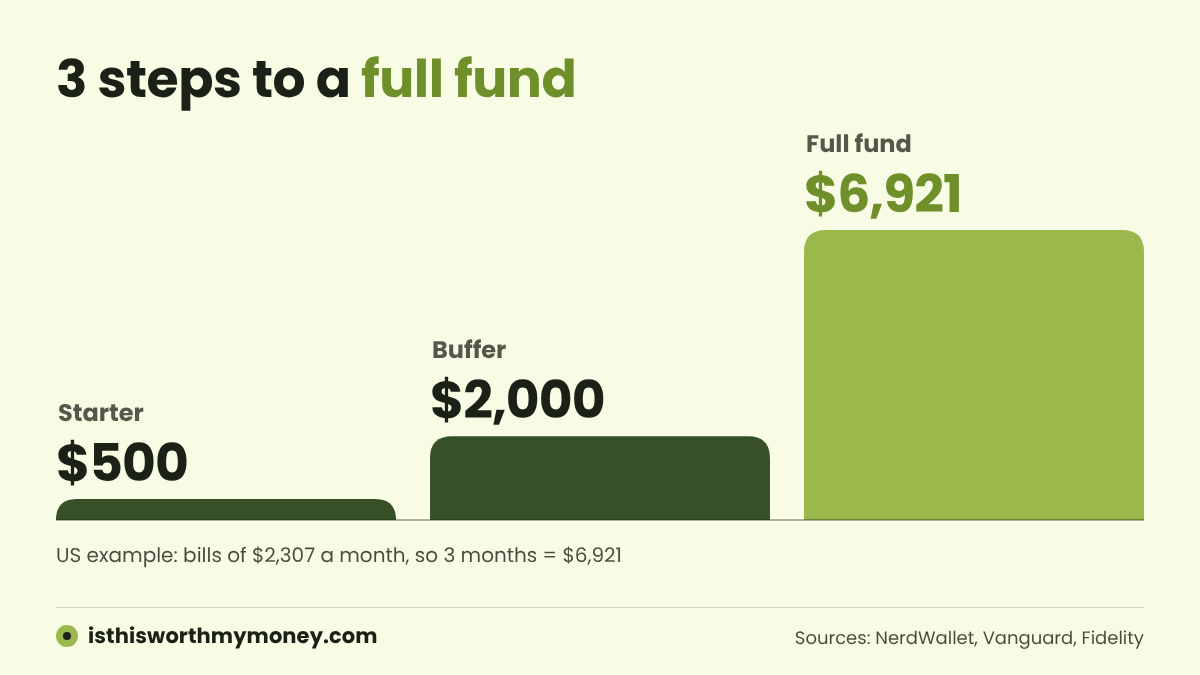
Your first emergency fund should be $500, and your first real stop is $2,000. The full target is 3 to 6 months of essential expenses, which How much should you save per month? covers in detail. This post is about getting there from zero, one milestone at a time.
The three milestones, using the US example:
| Milestone | Amount (US example) | In months of essentials | Why this step | Source |
|---|---|---|---|---|
| 1. Starter | $500 | 0.22 | Covers one important bill | NerdWallet, Oct 2026 |
| 2. Buffer | $2,000 | 0.87 | Vanguard threshold for fewer 401(k) withdrawals and cash outs | Vanguard, July 2025 |
| 3. Three months | $6,921 | 3 | Low end of the 3 to 6 months guidance | Fidelity |
Why start small? Most people need the money within a year:
- 59% of US adults had a major unexpected expense in the past 12 months. The most common were vehicle repairs (30%), house or appliance repairs (22%) and medical bills (21%) (Fed SHED 2025).
- Only 63% of US adults would cover a $400 emergency with cash or its equivalent. For adults aged 18 to 29 it's 45% (Fed SHED 2025).
The $2,000 step has the strongest evidence behind it. Vanguard found that people with $2,000 in emergency savings were 17 points less likely to take a 401(k) hardship withdrawal and 43 points less likely to cash out when they left a job.
Aim for six months instead of three if your income is irregular. Hourly workers' monthly income swings by about 15%, against about 5% for salaried workers, and only 39% of hourly workers have liquid emergency savings, against 71% of salaried workers (Vanguard). Not sure what your essential bills add up to? One of the best free budget calculators in 2026 will total them for you.
How long does it take to build an emergency fund?
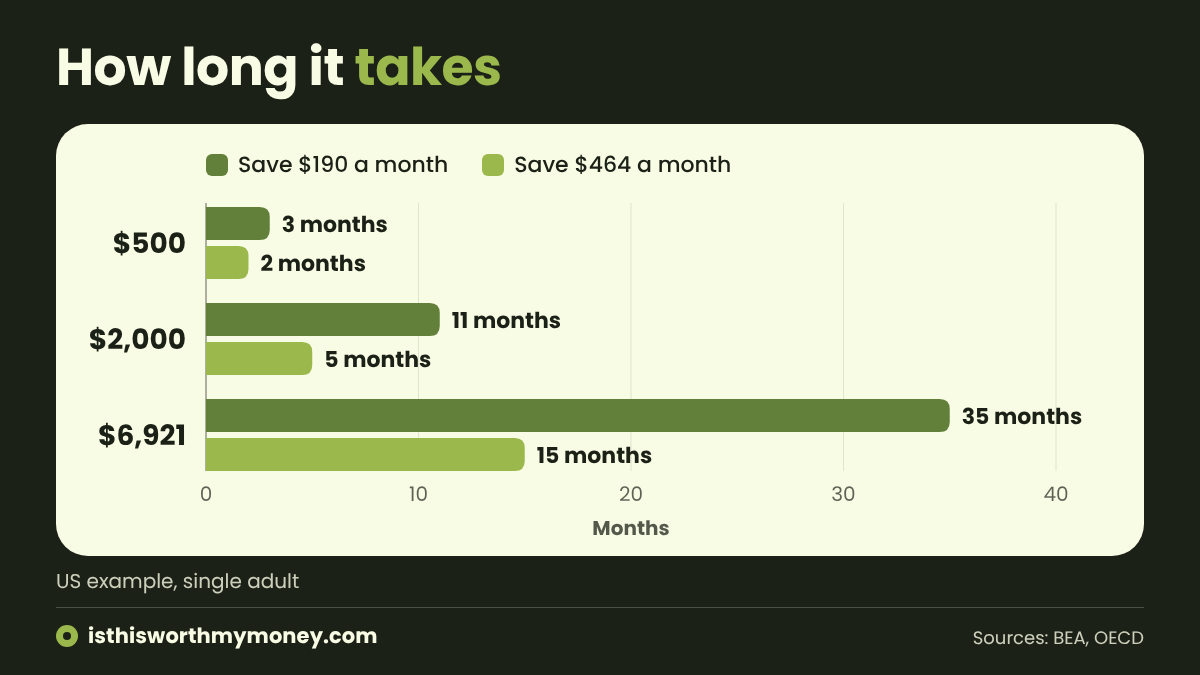
At the average US saving rate, about $190 a month, it takes 11 months to reach $2,000 and almost three years (35 months) to reach three months of essentials. Double the deposit and the timeline roughly halves.
Months to reach each milestone (single adult, no car, 4.00% APY):
| Monthly saving | $500 | $2,000 | 3 months ($6,921) | 6 months ($13,842) |
|---|---|---|---|---|
| $100 | 5 | 20 | 63 | 115 |
| $190.16 (4.1% saving rate) | 3 | 11 | 35 | 66 |
| $216.67 ($50 a week) | 3 | 10 | 31 | 59 |
| $250 | 2 | 8 | 27 | 51 |
| $463.80 (10% of take home) | 2 | 5 | 15 | 29 |
| $927.60 (20% of take home) | 1 | 3 | 8 | 15 |
What stands out:
- Interest only helps on the long stages. At 0%, the three month column becomes 70, 37, 32, 28, 15 and 8 months. The first $2,000 comes almost entirely from your deposits.
- A car stretches everything. With a car, essentials rise to $2,981 a month, and $190 a month takes 16, 44 and 83 months to reach one, three and six months of essentials.
- Three months of essentials equals 1.49 months of take home pay, and six months equals 2.98. That's because essential bills take about half of take home pay ($2,307 of $4,638).
Where do you find the first $500?
Start with a fixed weekly amount. $50 a week reaches $500 in 3 months and $2,000 in 40 weeks, about 9.2 months before interest.
- Set up an automatic transfer on payday to a separate savings account, so the money moves before you can spend it.
- Look for money you already spend without noticing. How to Audit Your Subscriptions walks through cancelling the ones you don't use.
- Give saving a fixed slot in your budget. The 50/30/20 rule sets aside 20% of take home pay for savings.
- For more ideas, see How to Save Money: 11 Weird Tricks.
Where should you keep an emergency fund?
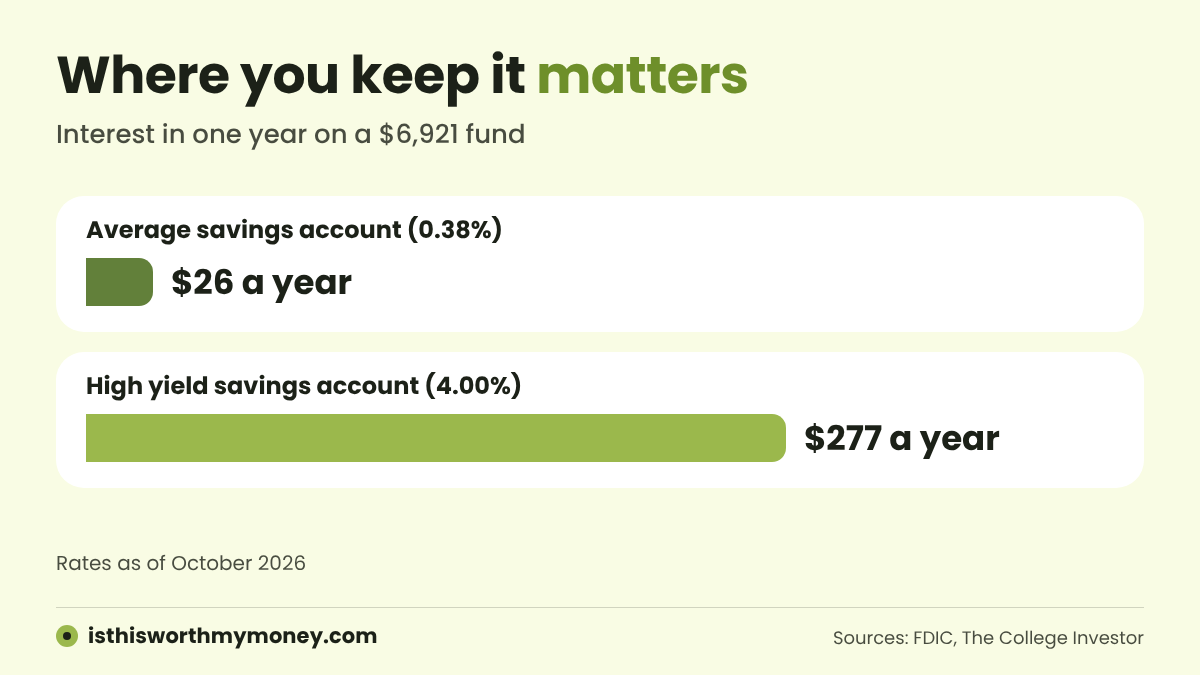
Keep it in a separate high yield savings account that is insured, easy to reach within a day or two, and paying around 4.00%. The national average savings account pays 0.38%, so the same fund earns about ten times as much interest in a high yield account.
What three and six months of essentials earn in one year:
| Where the money sits | Rate (Oct 2026) | Interest in one year on $6,921 (3 months) | On $13,842 (6 months) |
|---|---|---|---|
| National average savings account | 0.38% APY | $26.30 | $52.60 |
| National average money market account | 0.63% | $43.60 | $87.20 |
| High yield savings account, standard rate | 4.00% APY | $276.84 | $553.68 |
- Moving three months of essentials from an average account to 4.00% is worth $250.54 a year. For six months it's $501.08.
- Top online rates were 4.25% to 4.35% APY in mid October 2026, but the top rate includes a 0.35% boost that ends after six months. All of these rates are variable.
What to look for in the account:
- Separate from your spending account, so it doesn't get used for groceries.
- Money available within a day or two.
- Deposits insured. In the US, FDIC or NCUA insurance covers $250,000 per depositor, per bank, per ownership category. Outside the US, check your country's deposit guarantee scheme.
Should you pay off debt or build an emergency fund first?
Build the $2,000 starter fund first, then pay off high interest debt, then save the rest of the three months. Without a starter fund, the next emergency goes straight back on the card.
What an emergency costs when it goes on a card at 22.36% APR:
| Emergency put on a card (22.36% APR) | Repaid over 6 months | Repaid over 12 months |
|---|---|---|
| $400 | $71.08 a month, $26.49 interest | $37.51 a month, $50.09 interest |
| $1,000 | $177.70 a month, $66.22 interest | $93.77 a month, $125.21 interest |
| $2,000 | $355.41 a month, $132.44 interest | $187.54 a month, $250.43 interest |
- The starter fund comes first so the next car repair doesn't go back on the card you are paying down. 29% of US adults already have more credit card debt than emergency savings (Bankrate, December 2025).
- Debt comes before the full three months because the card costs 22.36% APR while savings earn 4.00% APY. APR and APY are different measures: the card's effective annual rate is 24.80%, so the real gap is even wider.
What should you do after you use your emergency fund?
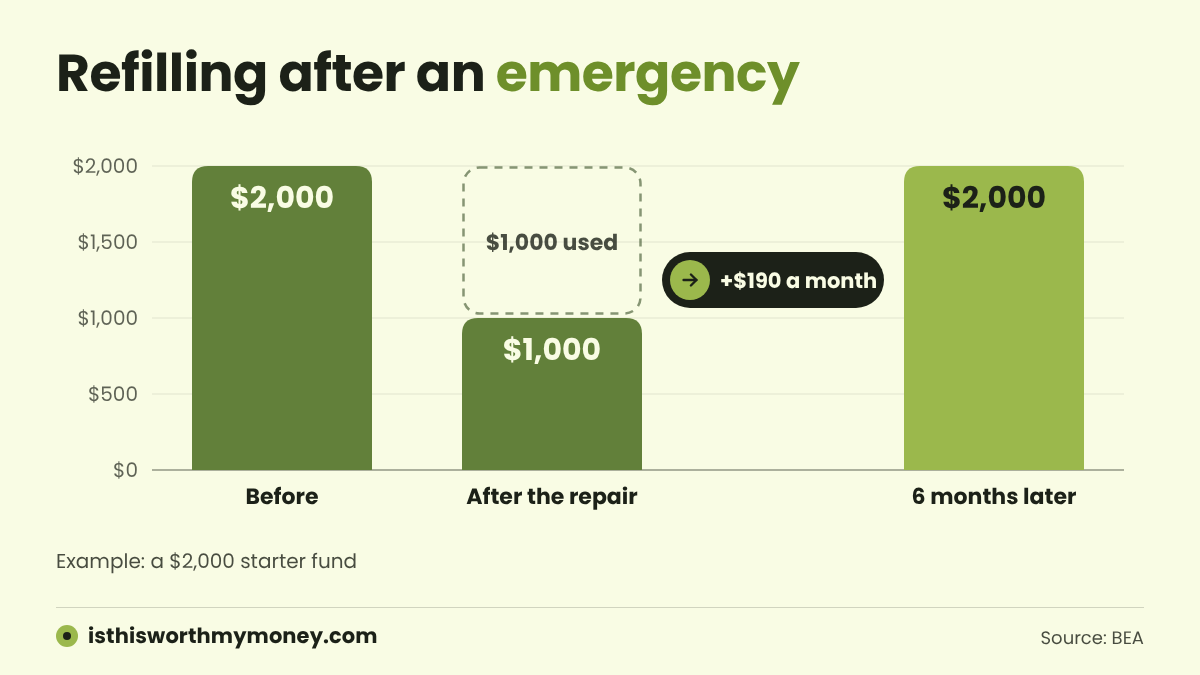
Refill it before you do anything else. Pause extra debt payments and other savings goals until the fund is back at its last milestone.
Using it is normal: 37% of US adults used emergency savings in the past 12 months (Bankrate, February 2025), and 58% had the same or less saved than a year earlier (Bankrate, December 2025).
What counts as an emergency?
An emergency is a cost you didn't plan for and can't put off. Anything you can see coming belongs in its own savings pot:
| Use the fund | Plan for it separately |
|---|---|
| Job loss or a drop in income | Holidays and gifts |
| Major vehicle repair (30% of US adults had one in a year) | Bills you know are coming, such as annual insurance |
| Major house or appliance repair (22%) | A new phone or other upgrades |
| Unexpected medical expense (21%) | Sales and deals |
How do you refill it?
Months to replace $1,000 at each monthly saving amount (4.00% APY):
| Monthly saving | $100 | $190.16 | $250 | $463.80 |
|---|---|---|---|---|
| Months to replace $1,000 | 10 | 6 | 4 | 3 |
At the average saving rate, one $1,000 repair sets you back six months. At 10% of take home pay it's three.
Emergency fund calculator: how much do you need to save each month?
To reach $2,000 in 12 months, you need to save $166.67 a month before interest, or $163.69 a month in an account paying 4.00% APY. Use the calculator below to set your own pace.
Building an emergency fund from scratch means getting to $2,000 before anything else. At the US average saving rate that takes 11 months; at 10% of take home pay, 5. Then clear any credit card debt at 22.36% APR, and only after that finish three months of essential bills (six if your income is irregular). Keep the fund in a high yield savings account earning around 4.00%, not an average account at 0.38%. On three months of essentials that's $250.54 more interest a year. One caveat: these timelines assume a steady deposit every month. An emergency on the way resets the clock, so a $1,000 withdrawal at $190 a month adds six months.
Sources: Fed SHED emergency savings · Fed SHED unexpected expenses · Fed SHED 2025 summary · Vanguard · Bankrate · BEA · Fed G.19 · FDIC rates via Banksparency · The College Investor · NerdWallet · Fidelity · OECD Taxing Wages 2026 · Numbeo: United States · KFF 2025 [VERIFY: confirm the 0.38% national average on fdic.gov]
The 50/30/20 rule - One of the most popular budgeting methods broken down. Learn how to split your income into needs, wants, and savings.