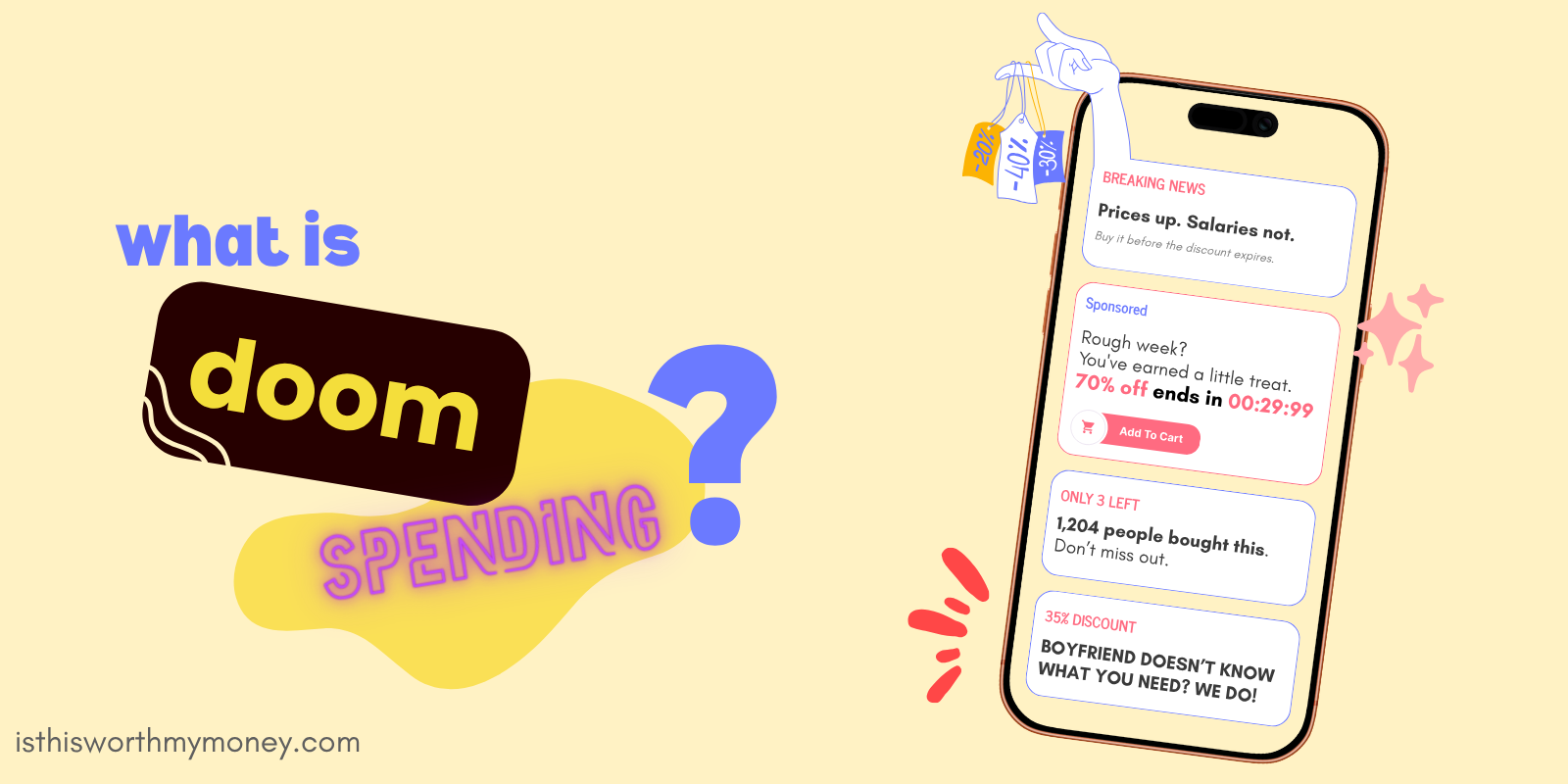
Everyone jokes about "treating yourself." But at some point the treats stop being celebrations and start being painkillers.
From the outside, doom spending looks exactly like normal shopping. The difference is what's driving it, and how you feel once the box is open and the novelty wears off.
Sometimes there's an obvious trigger, like one bad night of doomscrolling. Just as often there isn't. A job that's been grinding you down for months, a rough patch in a relationship, or a general sense that things are not okay can all do the job quietly, and buying things becomes the one reliable dose of relief.
Let's talk about what doom spending actually is, how to tell it apart from a harmless treat, and how to stop without banning yourself from ever buying anything fun again.
The Quick Answer
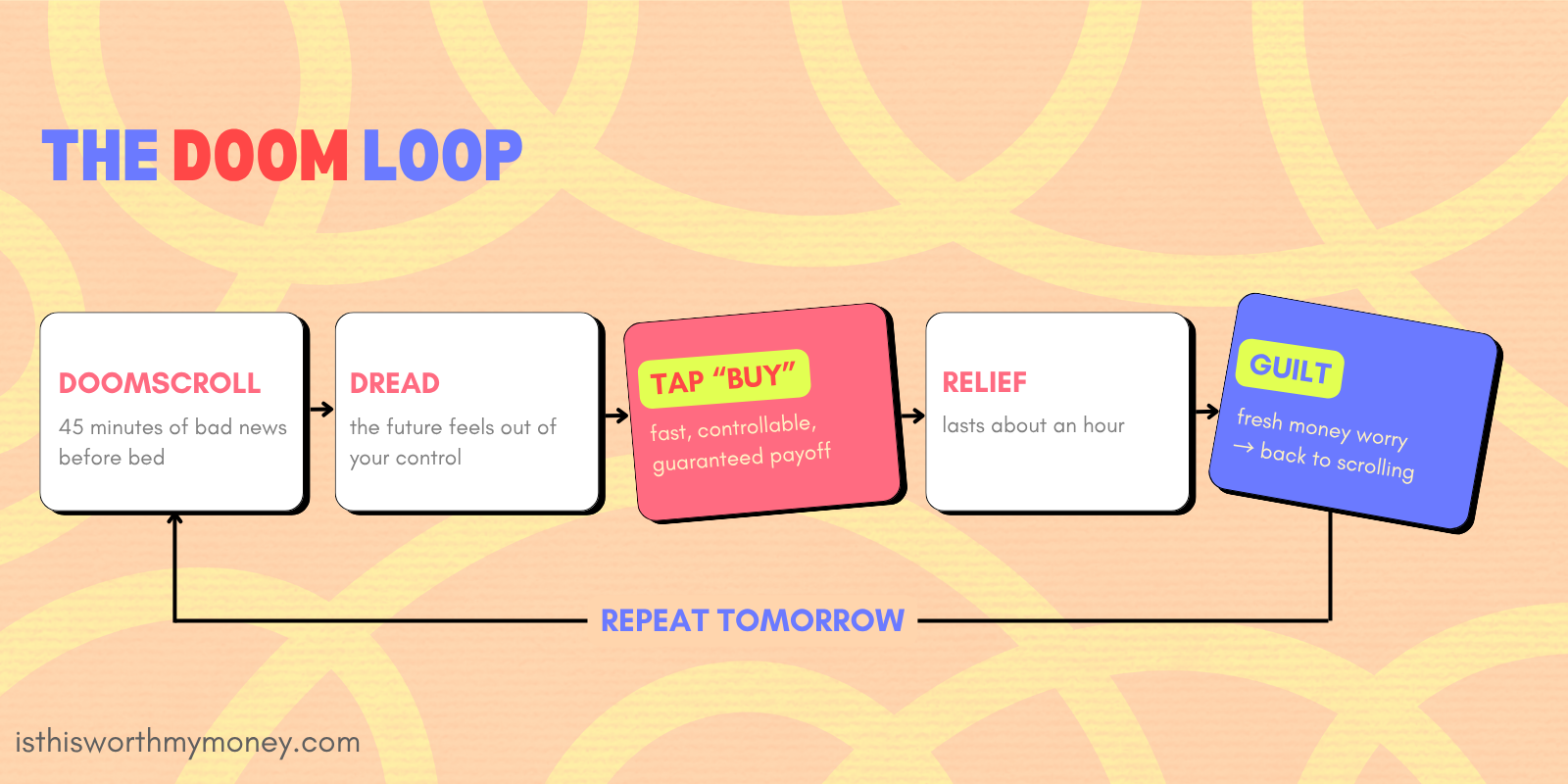
Doom spending is impulsively buying things you don't need, and often can't afford, to soothe anxiety about the future: the economy, the news, your own finances. It usually follows a round of doomscrolling, gives you a quick dopamine hit, then leaves guilt and a thinner bank account behind.
It's most common among Gen Z and millennials. The fix has less to do with willpower than with noticing the trigger and adding a little friction between the feeling and the purchase.
What is doom spending?
Doom spending means spending money to soothe your dread about the future rather than to meet an actual need. The item in the cart barely matters. The world feels heavy, and tapping "buy" feels like doing something about it.
The name is a cousin of doomscrolling for a reason. Anxious scrolling and shopping ads live in the same feed, on the same phone, a couple of taps apart. You read something scary about inflation, and the next post is a sale. Nothing stands between the panic and the purchase, which is exactly the problem.
Why does the brain fall for it? When everything feels out of control, a purchase offers the opposite: something fast, something you chose, with a small guaranteed payoff at the end. You can't fix the economy, but you can get that thing shipped by Thursday.
About 27% of Americans admit to doom spending to cope with stress, and that jumps to 37% of Gen Z and 39% of millennials, according to a Credit Karma survey. More than half of Gen Z say bad news online is what pushes them to spend in the first place.
It's the same quiet math behind the latte factor: no single stress purchase feels like much, until you add up a whole anxious year of them.
Younger generations are hit hardest. Roughly 1 in 3 Gen Zers and millennials say they doom spend to cope with stress.
Doom spending vs retail therapy: what's the difference?
The line comes down to how you feel afterward. Retail therapy usually leaves you a little better. Doom spending usually leaves you worse.
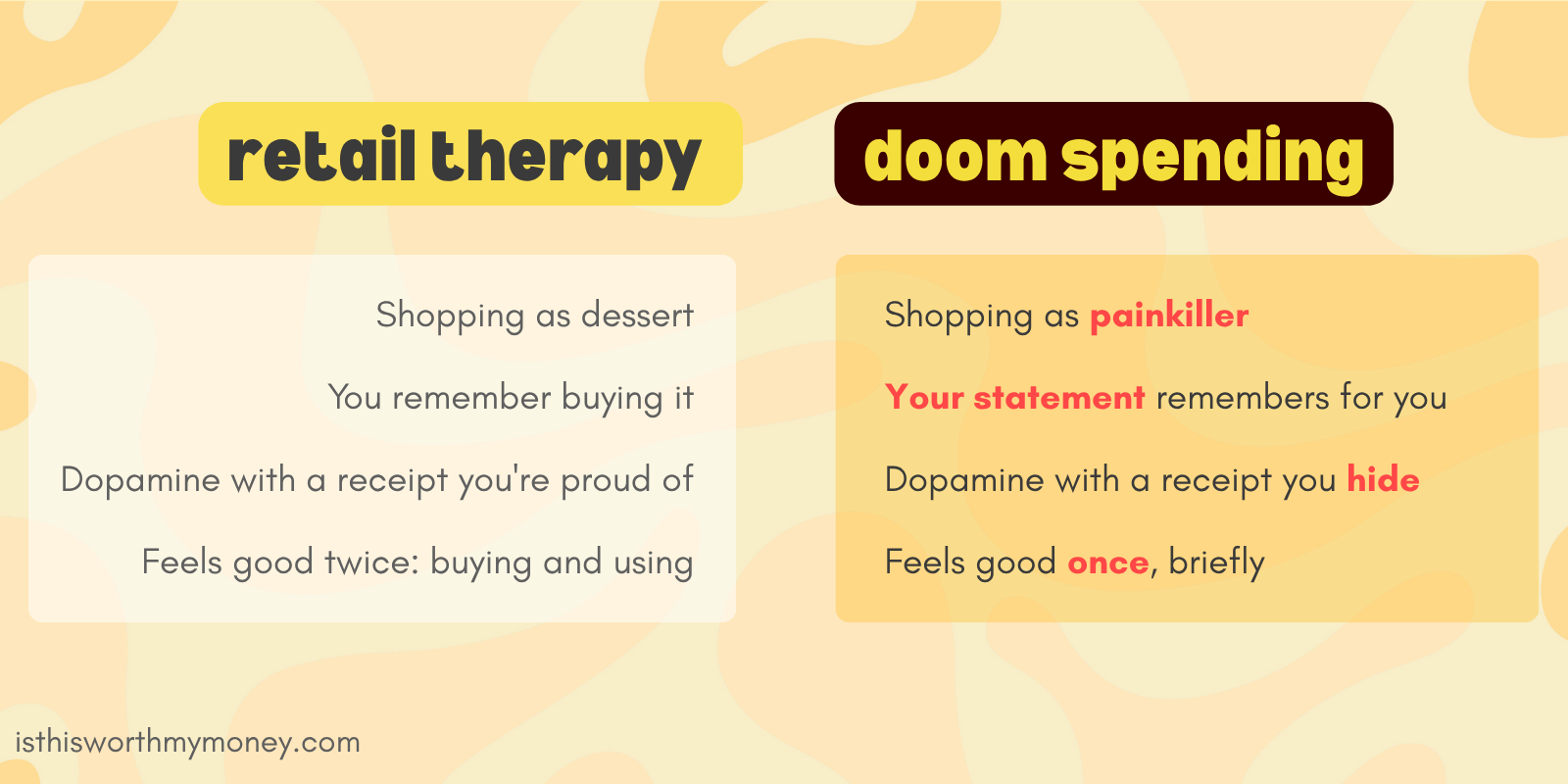
Retail therapy is occasional and semi planned. You had a rough week, you'd been eyeing those shoes anyway, so you buy them as a small celebration and enjoy them with zero regret. It's a treat tied to a reward, and it stays in its lane.
Doom spending is reactive and frequent. Something scary happened, and the purchase is the flinch. Then the relief fades within the hour and the guilt moves in to replace it.
So here's the simplest gut check, and it costs you nothing: the aftermath test. A day later, does the purchase still feel good, or does it just feel like a mess you have to deal with? If you're quietly hoping the package doesn't arrive while your roommate's home, that wasn't therapy.
Am I doom spending?
If a few of these sound uncomfortably familiar, you've probably got the habit:
- Your credit card statement surprises you. You open it at the end of the month and genuinely don't remember half the charges. Small purchases you can't account for are the clearest tell.
- Your purchases follow bad news. The buying happens right after a heavy social media session or a doomscroll spiral, when you're anxious rather than celebrating.
- The good feeling doesn't last. The relief flips into guilt or fresh money worry within a day, sometimes within the hour.
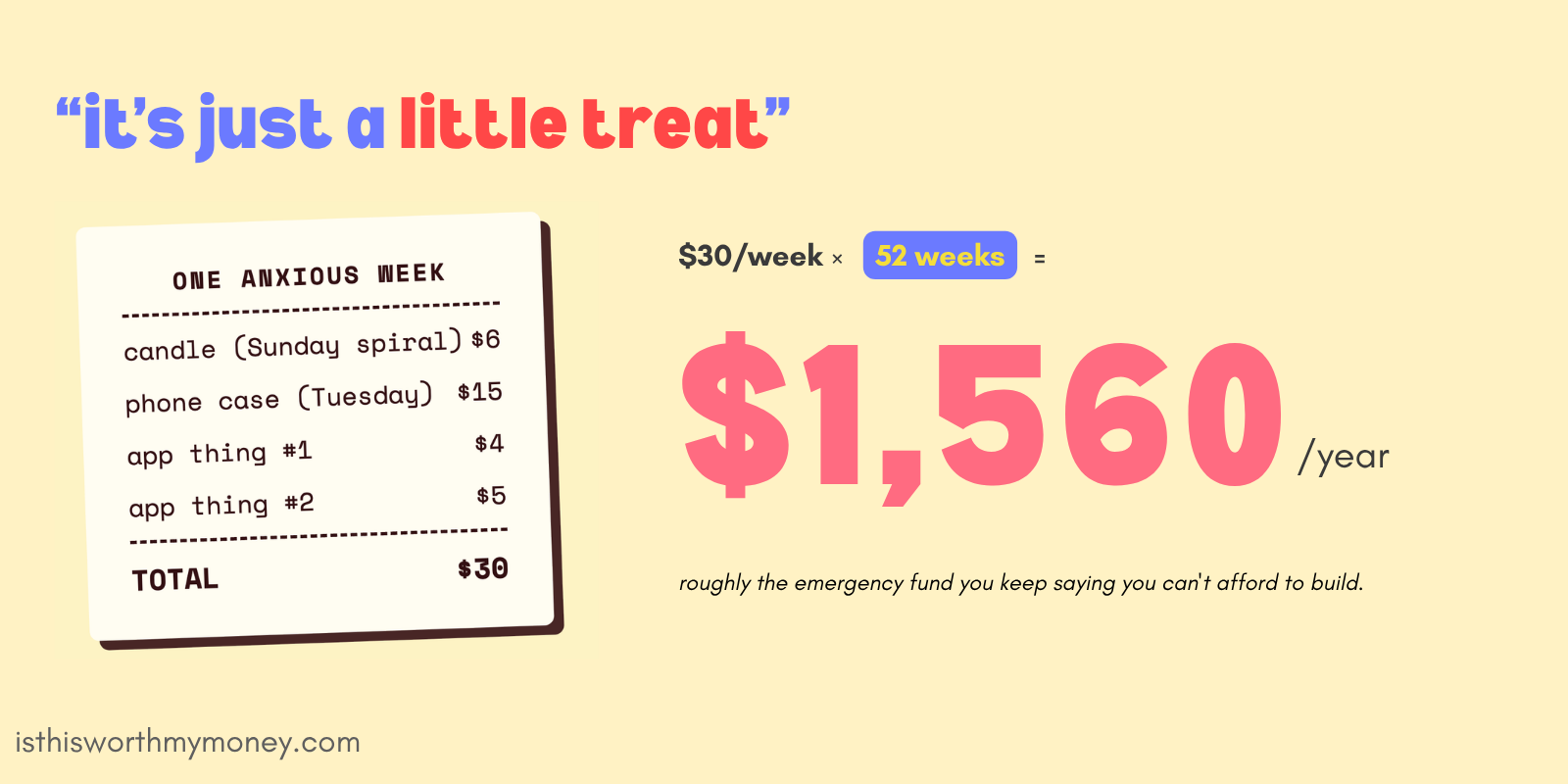
- It's lots of small things. You're not saving up for one deliberate splurge. It's a $6 candle here, a $15 phone case there, over and over.
None of these makes you irresponsible. They just mean stress found the easiest exit your phone offers. And a habit with clear triggers is a habit you can interrupt.
Track your number
Small stress purchases hide because they're small. They only get scary once you see them added up into a single yearly figure.
Try it with a typical week: the $6 candle after Sunday's doomscroll, the $15 phone case on Tuesday, a couple of $4 app purchases you barely registered. Call it $30 a week. That's about $1,500 a year, which for a lot of people is the emergency fund they keep saying they can't afford to build.
How to stop doom spending
You stop doom spending by adding friction. The purchase happens in the 30 seconds between feeling anxious and tapping "buy," so the whole game is making those 30 seconds slower and more boring.
Five tactics:
- Name the trigger. For one week, just notice the pattern: scroll, feel bad, shop. A quick look at your screen time is the cheapest diagnostic you've got. You can't interrupt a habit you can't see.
- Add friction to checkout. Delete your saved card details from your favorite retailers and pull the shopping apps off your home screen. Retyping a 16 digit card number is a surprisingly effective speed bump. Half the time you'll give up before you finish.
- Give it a lane. Total bans backfire. A small, guilt free "fun money" line in your budget works far better than white knuckling it to zero. When impulse spending has a home, it stops raiding the rest of your money. If you want a simple framework, our 50/30/20 rule guide shows where that line fits.
- Automate savings first. Move money to savings the day you get paid, before it can sit in checking looking spendable. Money you never see is money you can't doom spend.
- Use the 24 hour rule. For anything over a set amount, make yourself wait a day. If you still want it tomorrow, buy it. Most doom purchases don't survive a good night's sleep. Pair this with an audit of your subscriptions to catch the stress buys that quietly renew every month.
Willpower is overrated here. Friction between the feeling and the "buy" button does most of the work.
Doom spending is real, it's understandable, and it's still quietly costing you money you'll want later. When the world feels like it's on fire, buying something is one of the few moves that's fast and entirely within your control. That instinct is human. It's also expensive.
You can't control the economy or the news. You can control the 30 seconds between feeling anxious and tapping "buy."
So forget aiming for zero impulse purchases. That's a diet nobody keeps. Make your stress spending slow and deliberate instead of fast and automatic: add the friction, give yourself a small guilt free lane, and above all, know your number. Once you've seen what a year of "little" stress buys adds up to, the habit gets a lot easier to break.