A glance at the answer
Yes, Germany is cheaper in dollars. Essential bills for one adult run about $1,590 a month in Germany vs $2,300 in the US, about 31% less. But take-home pay is 28% lower too. After essential bills, a German worker keeps 52.5% of take-home pay. The average American keeps 50%, or 36% if they drive. Germans also save more of what’s left: about 10% of income vs 4% in the US.
How we compared:
- One adult, full-time job, renting a 1-bedroom alone.
- Take-home pay is after tax and payroll deductions.
- Prices are national averages, converted at the ECB rate on 19 October 2026 (1 EUR = $1.12).
- Health insurance only counts when you pay it on top of your salary. In Germany it already comes out of pay.
How much do people earn in Germany vs the US?
The average American takes home about 39% more than the average German, mostly because Germany takes a much bigger cut before payday.
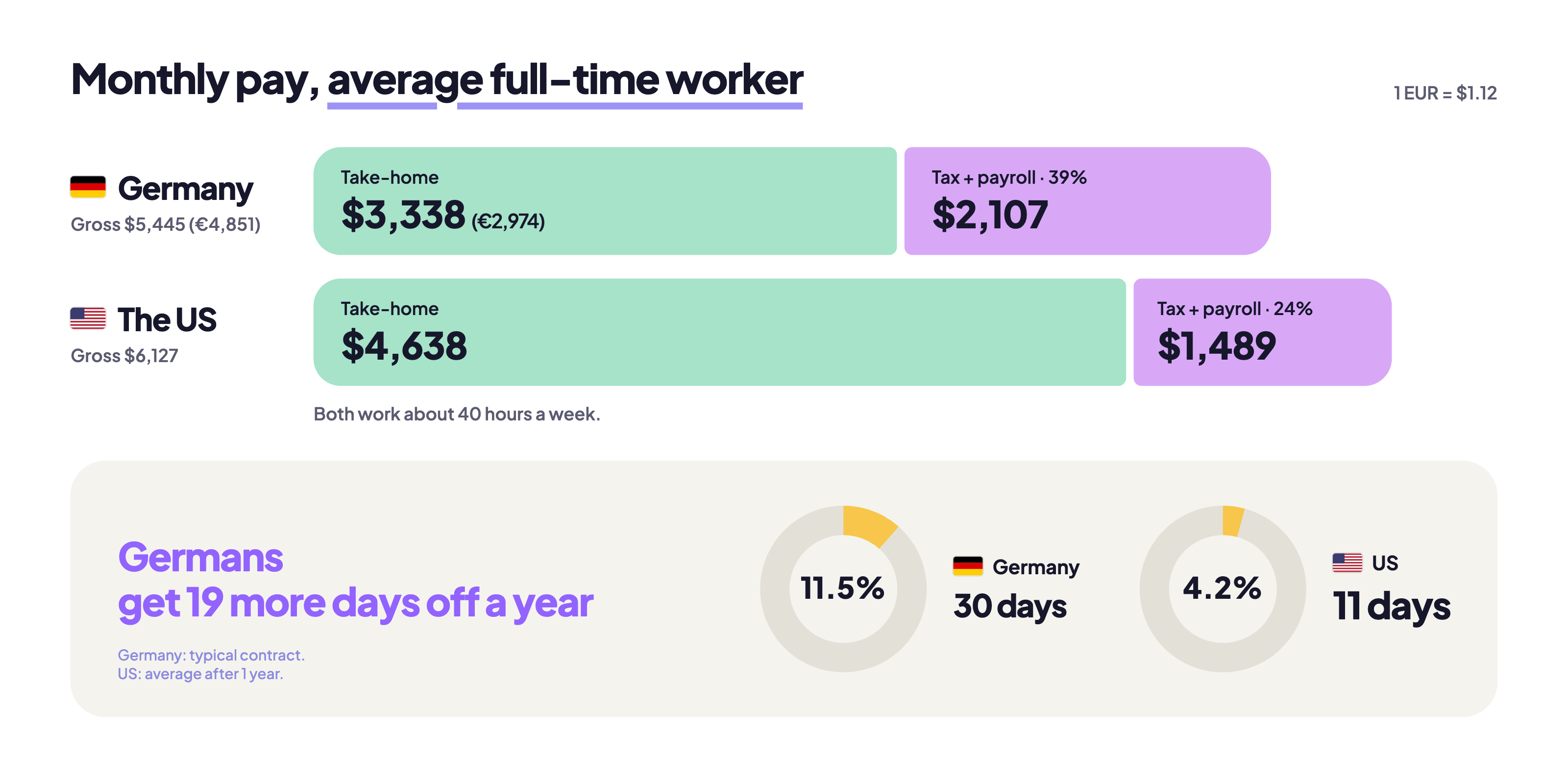
Where the 39% goes: income tax plus pension, unemployment, health and long-term care insurance. Health and care alone take about €541 ($607) a month from an average German paycheck.
- Vacation is the big gap. Most German collective agreements give 30 days. The US has no legal minimum, and private-sector workers average 11 days after a year on the job.
- Fewer hours overall: Germans work about 1,332 hours a year vs 1,800 in the US (OECD, all workers including part-timers).
How much is rent in Germany vs the US?
A 1-bedroom outside the city center costs $1,339 in the US and $706 in Germany. Germany wins nationally. Its big cities cost more, but nowhere near New York.
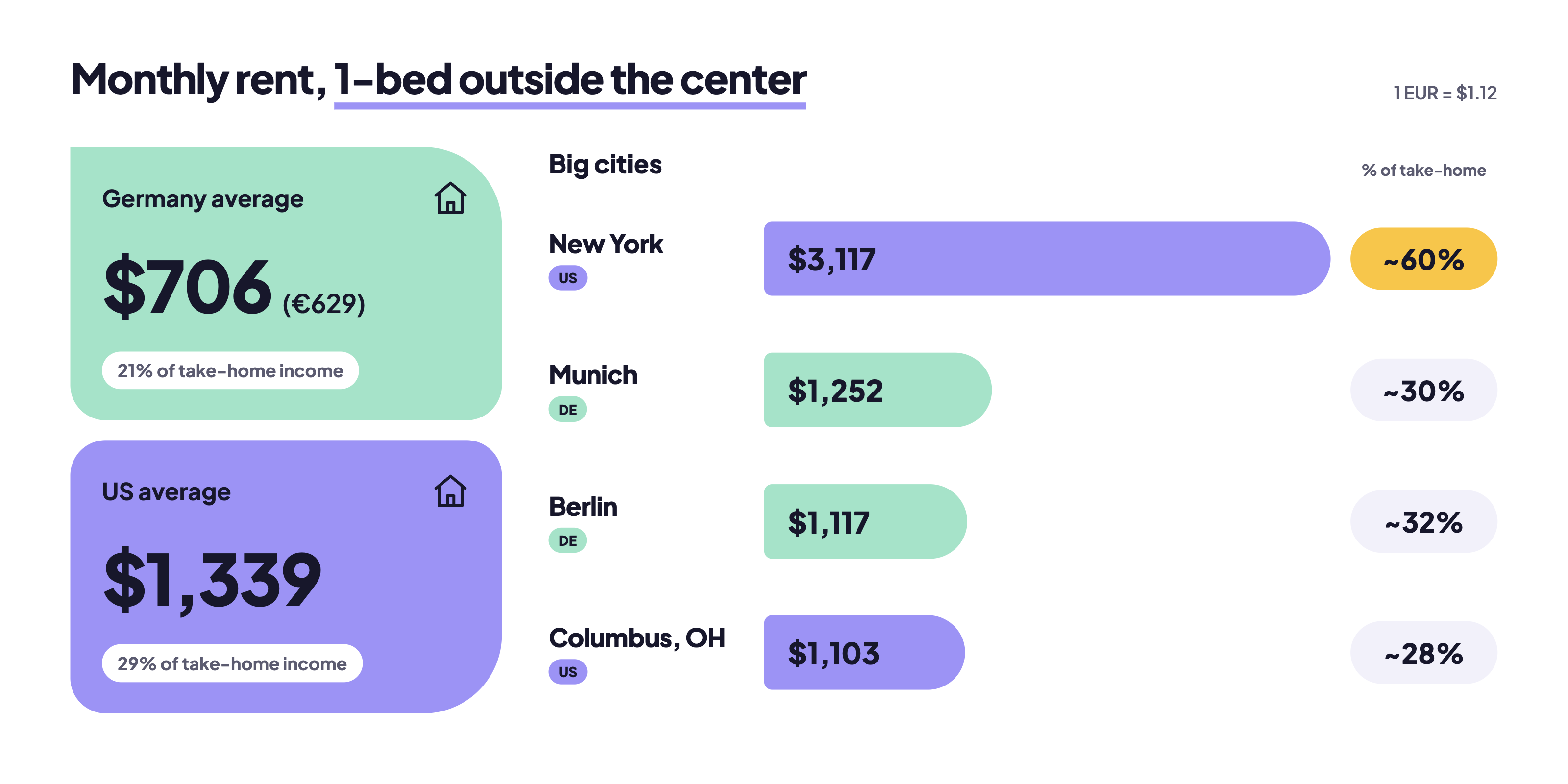
City rows compare rent with each city’s own average take-home pay.
- Germany is a renter’s country. About 58% of German households rent, and in Berlin it’s about 84%.
- Deposits are big: landlords can ask for up to 3 months of cold rent (Kaltmiete, rent before service charges).
- Service charges come on top. Heating, water, building cleaning and similar costs average €2.67 per m² a month, about €134 for a 50 m² flat.
- The US squeeze: 49% of American renter households spend more than 30% of income on housing, a record high. The 50/30/20 rule caps all your needs, rent included, at 50% of take-home pay.
How much are monthly bills in Germany vs the US?
Germany wins on phone and internet. The US wins on energy, gas and what health insurance takes from your paycheck.
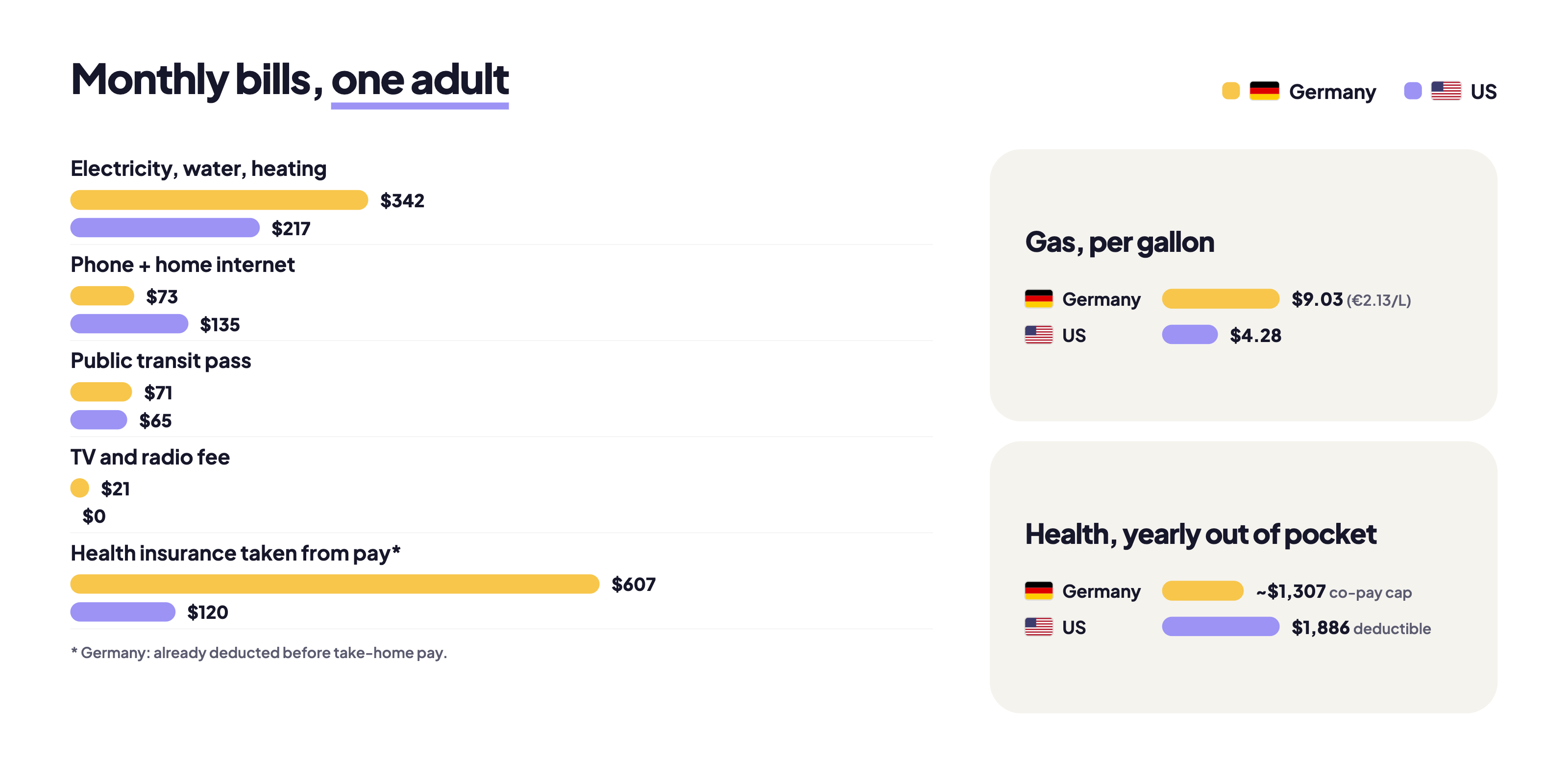
Electricity is the German pain point. Households pay about €0.39 per kWh, the second highest price in the EU (average €0.29).
- Gas is more than double. Super E10 averaged €2.13 a liter in early October 2026, even with a temporary 17-cent tax cut that runs until December.
- One ticket, the whole country. The €63 Deutschlandticket covers buses, trams, subways and regional trains anywhere in Germany. It rises to €66.80 in January 2027.
- Everyone pays the broadcast fee. The €18.36 Rundfunkbeitrag funds public TV and radio, and every household pays it whether or not they own a TV.
- Health costs hide in different places. A German pays about $607 a month for health and long-term care insurance before seeing a doctor, then small co-pays: €5-10 per prescription and €10 a day in hospital. An American pays $120 a month, then a $1,886 deductible before most coverage starts. German co-pays rise by 50% in January 2027.
- Cars: 77% of German households own one and 65% of workers drive to work. In the US, only 8% of households go without a car, and a used-car payment plus insurance averages $739 a month. Weighing that bill? See whether an electric car is worth it.
How much do groceries cost in Germany vs the US?
Every item below is cheaper in dollars in Germany. Measured in minutes of work, the US still wins on most of them.
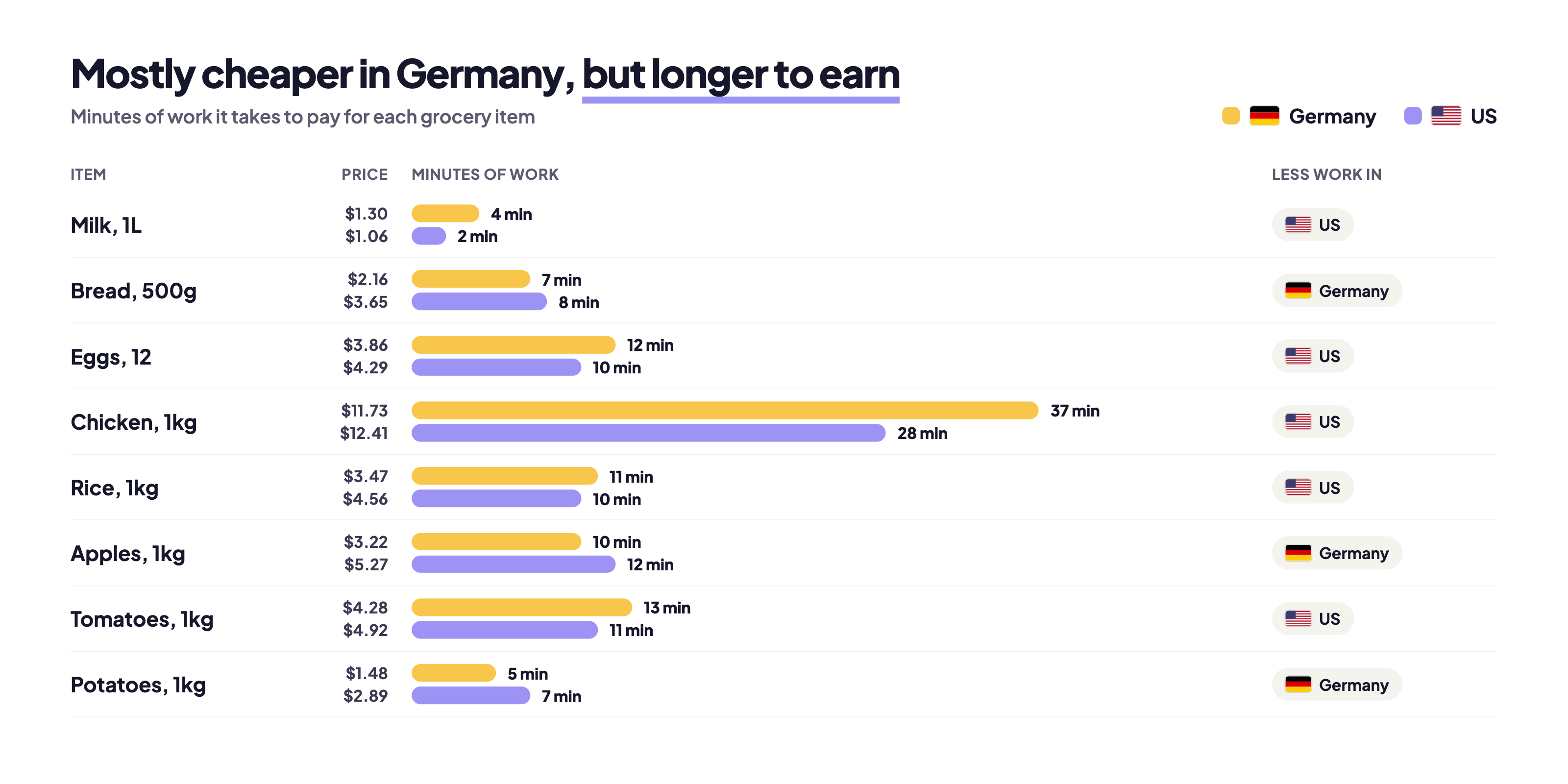
A full month of food for one adult costs about $430 in the US (9% of take-home) vs $375 in Germany (11%), based on Numbeo’s estimates for a Western-style diet.
One German extra at the checkout: a 25-cent deposit (Pfand) on every single-use bottle and can, which you get back when you return it.
What’s left after the bills?
The US keeps more dollars. Germany keeps a slightly bigger share, and a much bigger one if the American drives.
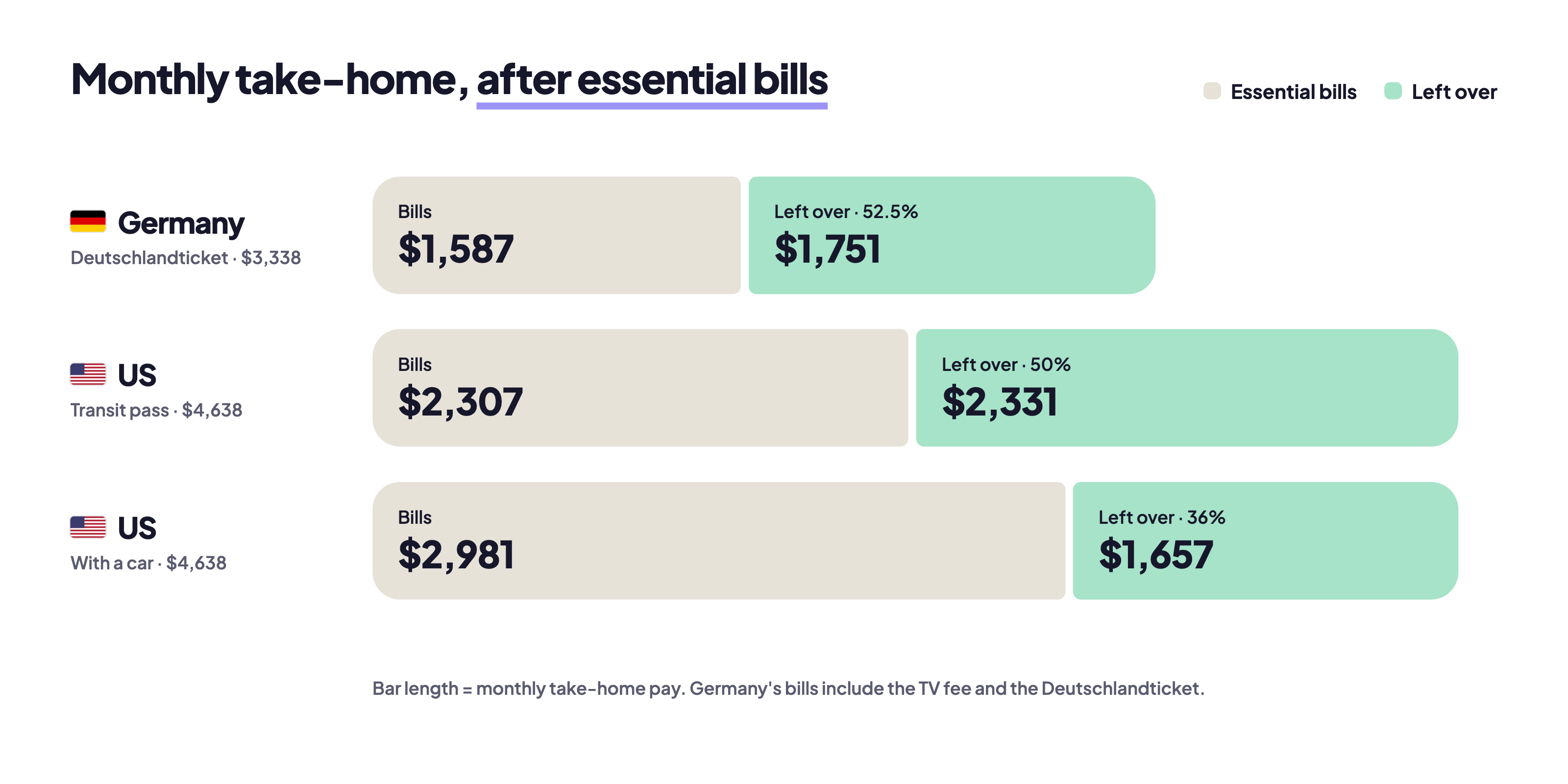
Germany’s bills include the TV fee and the Deutschlandticket. Most Germans also own a car, but at $9 a gallon, plenty of city dwellers skip it.
What about everything else?
The table above only covers essentials. Eating out, coffee, clothes and the gym all come out of what’s left over.
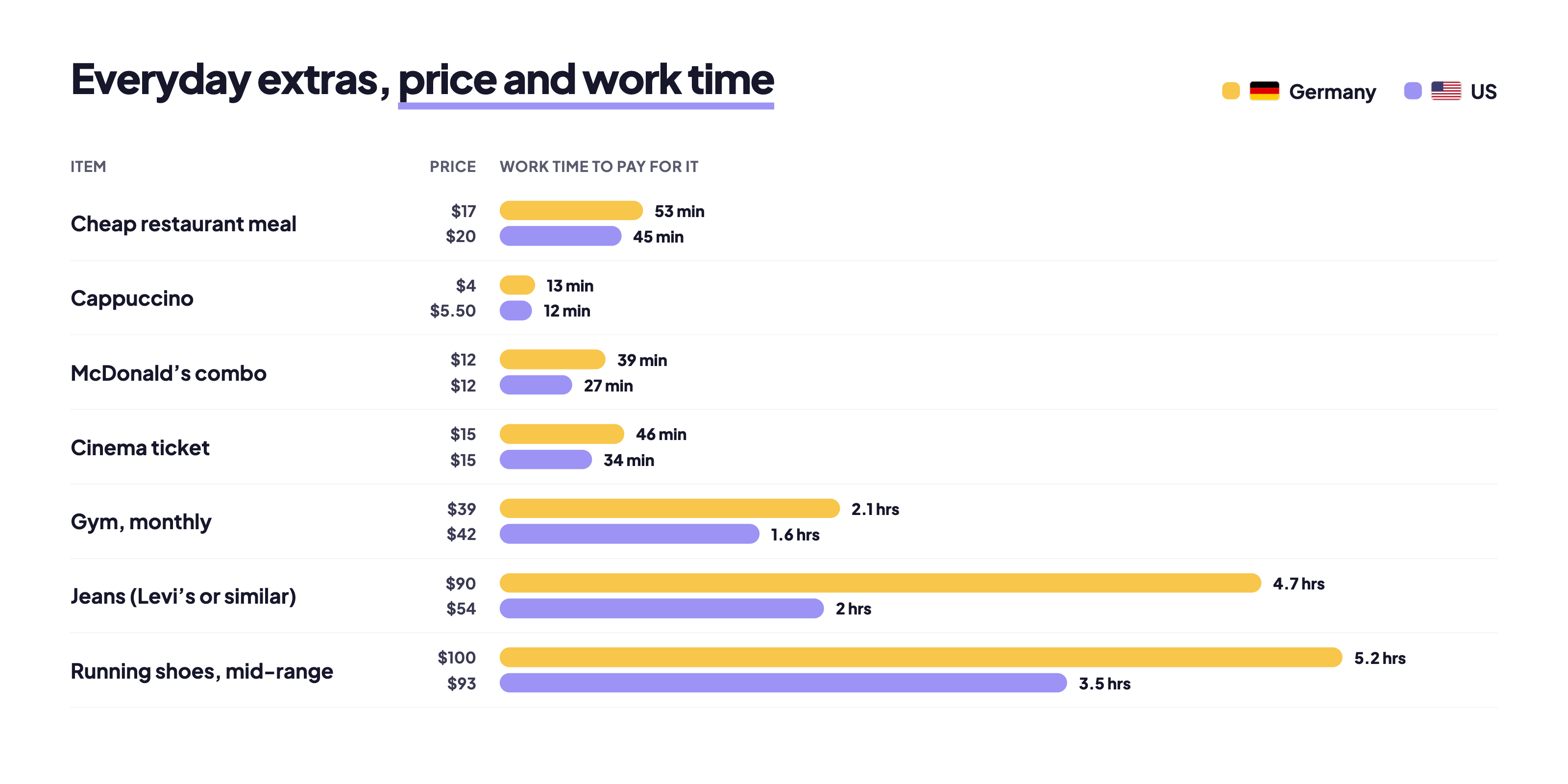
Most extras cost about the same in dollars, but take longer to earn in Germany. Clothes are the exception: Levi’s cost $90 in Germany vs $54 in the US, more than twice the work time.
So how much do people actually save?
"Left over" isn’t the same as "saved." Here’s what people really keep:
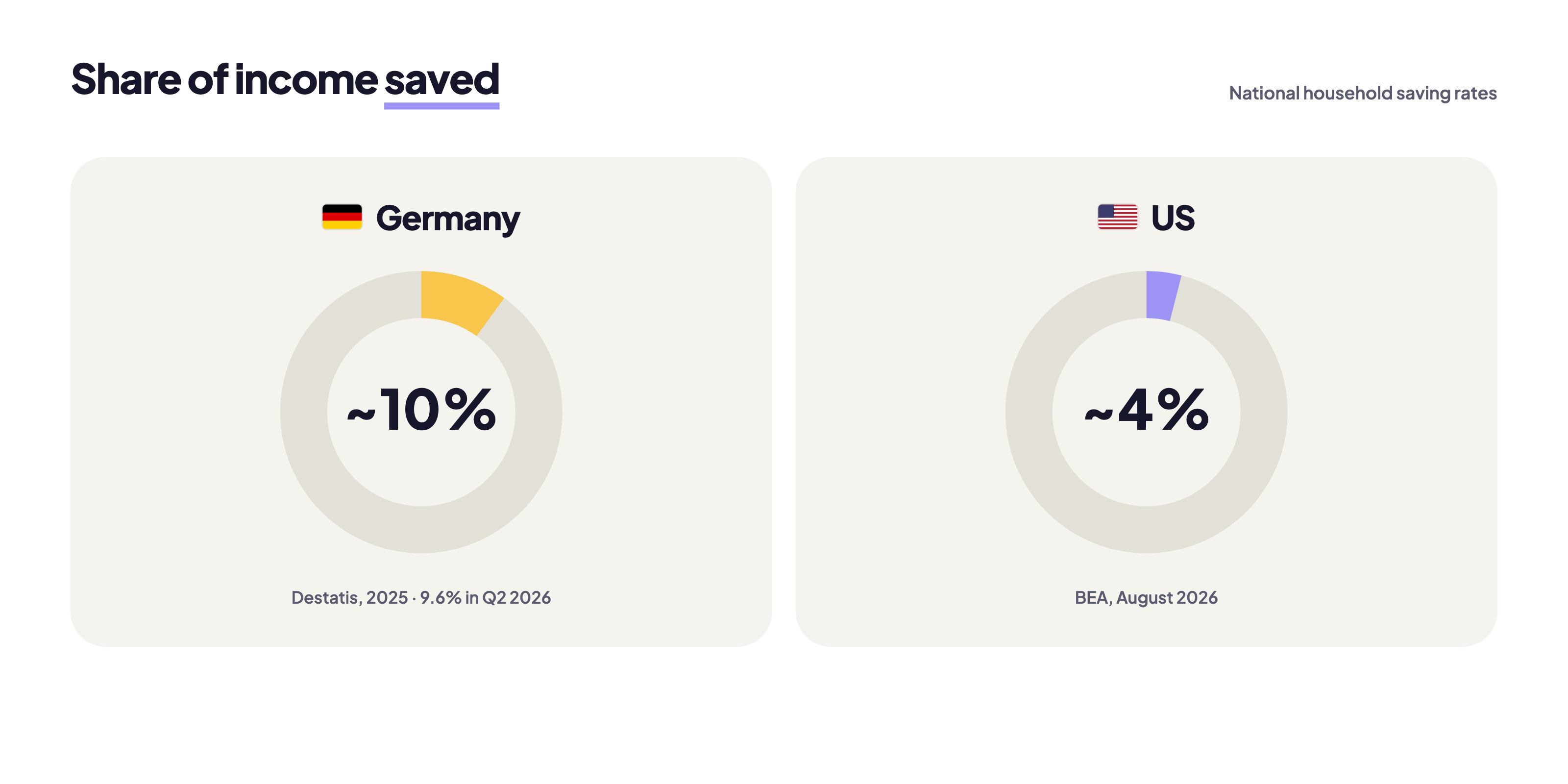
- US: about 4% of income (BEA, August 2026).
- Germany: about 10% of income (Destatis, 2025). It was 9.6% in the second quarter of 2026.
These are national averages, including homeowners and retirees. Still, Germans keep more than twice as much of their income as Americans do.
The scorecard:
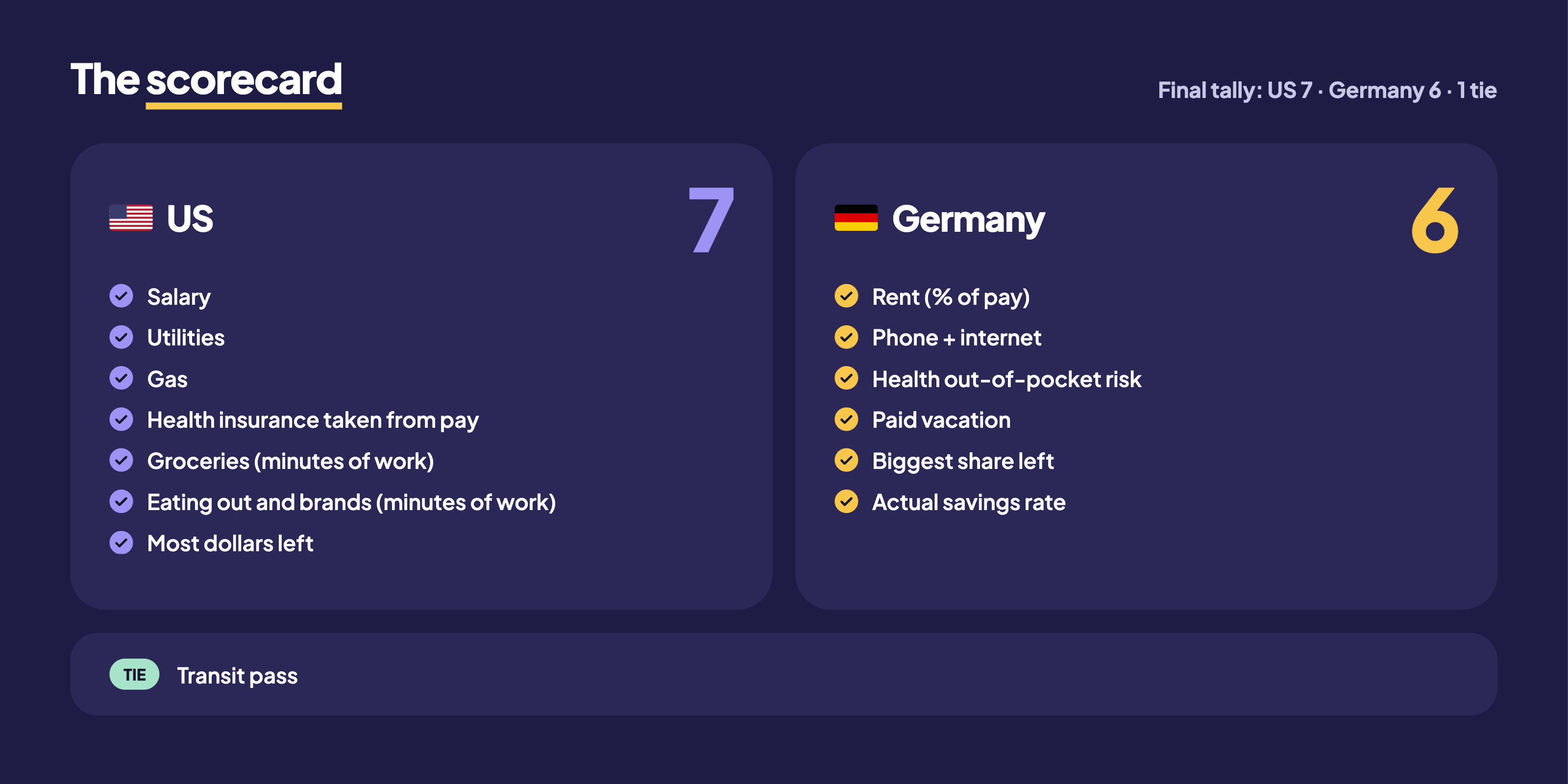
Germany is cheaper than the US on rent, phone bills and doctor visits. The US is cheaper on energy, gas and almost anything you buy for fun. The real difference is how you get paid. Americans take home more money. Germans take home less, but get health cover with small co-pays, 30 days off and a slightly bigger share left after the bills, and they save more of it. If you want the biggest paycheck, the US wins. If you want the most time off and the least medical risk, Germany does.
Try It Yourself
Enter your take-home pay and monthly bills to see what you keep, and which row in the table above you’re closest to.
Sources: Numbeo: Germany · Numbeo: United States · Numbeo: Berlin · Numbeo: Munich · Numbeo: New York · Numbeo: Columbus · OECD Taxing Wages 2026 · Destatis: gross earnings · Destatis: median pay 2025 · Destatis: weekly hours · OECD annual hours (Korea Times) · WSI: vacation days 2026 · BLS: paid vacation days · Haufe: social insurance rates 2026 · Destatis: home ownership · Mieterbund: service charges · Sparkasse: rent deposit · Harvard JCHS 2026 · Eurostat electricity prices · Deutschlandticket · Rundfunkbeitrag · ADAC fuel prices (ms-aktuell) · EIA gas prices · Destatis commuting (ZDF) · UBA: car ownership · Experian auto finance · NerdWallet car insurance · KFF 2025 · CMS health spending · vdek: co-pays · Co-pays rise in 2027 · Eurostat out-of-pocket share · Verbraucherzentrale: Pfand · Destatis saving rate 2025 · Destatis saving rate Q2 2026 · BEA personal saving rate · ECB exchange rates
Cost of living in China vs the US (2026) - A comparison between how much people spend and save in China and the US